The Frankfurt/Hahn Airport is benefiting from an upgrade to its facilities as well as its road links that will help cope with increased traffic. The site was commissioned as a civilian airport in 1993 and is one of the fastest growing German airports as well as being the fourth largest cargo airport in Germany.

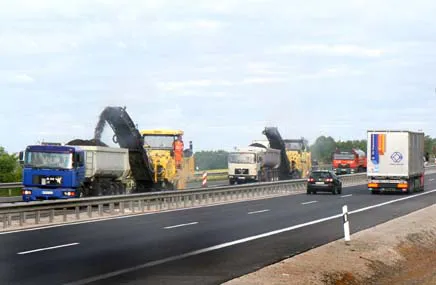
The Frankfurt/Hahn Airport is benefiting from an upgrade to its facilities as well as its road links that will help cope with increased traffic. The site was commissioned as a civilian airport in 1993 and is one of the fastest growing German airports as well as being the fourth largest cargo airport in Germany. Upgrade work to the B50 Bundestrasse that connects with the airport is of prime importance and contractor Beitz-Fräsdienstleistungen is widening a 7.5km section of the road. The work will see the road widened and upgraded from two lanes to four-lane and this has been speeded by the high productivity of 172 Bomag planing equipment.
The work was carried out in three different stages with the first stage being planing to a depth of 40mm over a length of 7.5km, an area of 50,000m2. This work removed around 4,500tonnes of material and 180 truck loads were required to haul the milled cuttings away. The second stage was the milling of another 4,500m2 of surface to improve weak points in the road structure, which removed 1,350tonnes of binder and base layers and required a further 55 truck loads to haul the material away. The third and final stage of the milling job was to remove a 150m stretch of 6m wide binder and base layers to a depth of 320mm in front of bridges and this required the removal of 700tonnes of material in a further 28 trucks. In all the milling work required some 6,550tonnes of material to be removed.
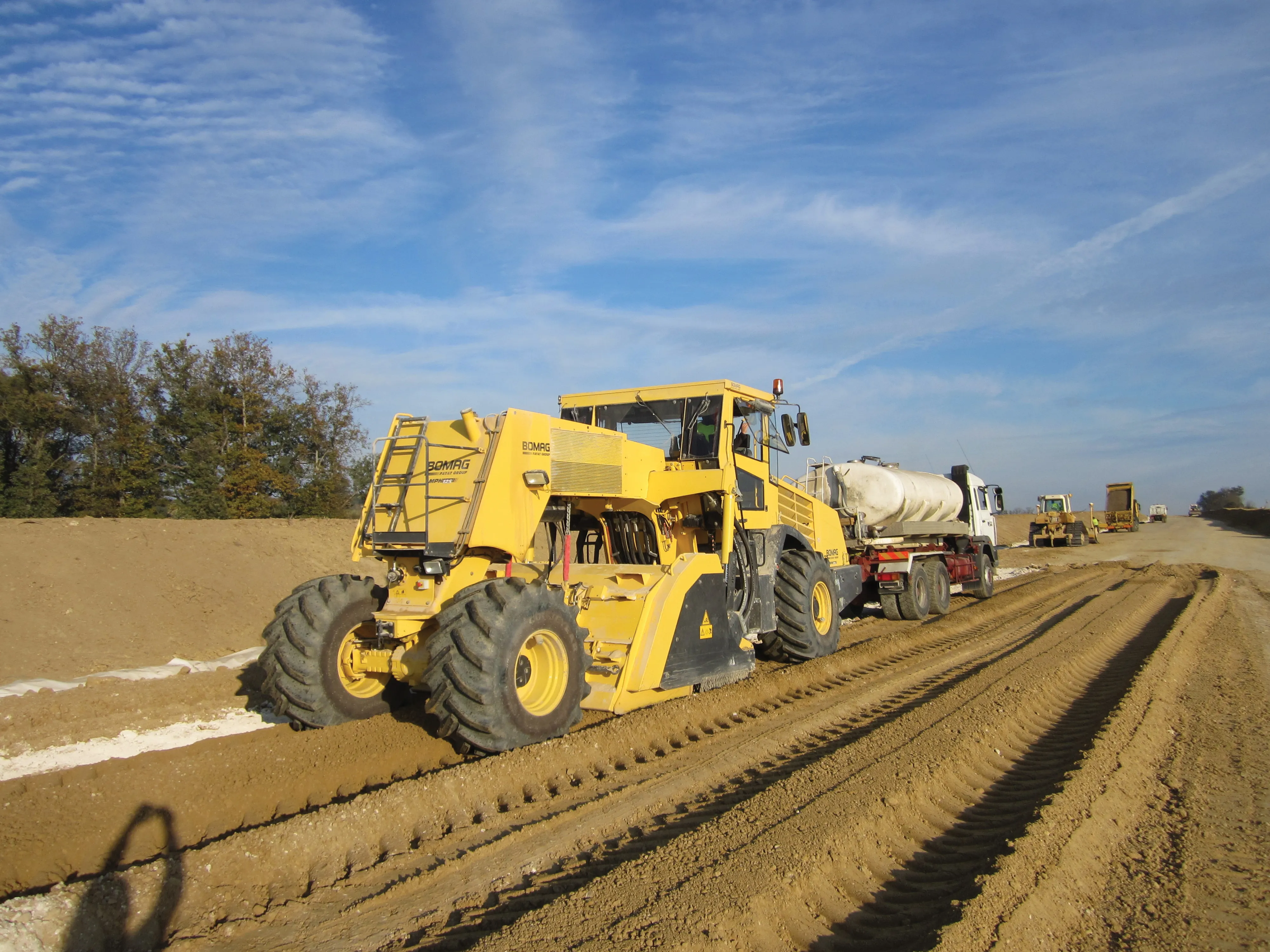
The work had to be finished within a tight time frame and the BOMAG BM 2000/60 cold planers worked reliably and productively within the schedule. The planing work had to be completed within a single week during the day from 06.30-17.00 and with a public holiday on the Thursday, the time frame was tighter still. In spite of the surface layer being hard and only a few years old, an average milling speed of 25 m/min was achieved over the 7.5km during the first stage of the planing work. This gave a perfect, clean planed surface that allowed for quick, precise re-laying of the new surface and reduced the time needed for sweeping the road afterwards. During all three stages the average fuel consumption was an encouraging 60-65litres/hour, while cutter wear was minimised due to the effective water spraying system for the planer. Productivity was further boosted by the automatic settings that returned the cutting depth to the same height when each truck carrying the milled material was moved into place under the discharge conveyor.
The work was carried out in three different stages with the first stage being planing to a depth of 40mm over a length of 7.5km, an area of 50,000m2. This work removed around 4,500tonnes of material and 180 truck loads were required to haul the milled cuttings away. The second stage was the milling of another 4,500m2 of surface to improve weak points in the road structure, which removed 1,350tonnes of binder and base layers and required a further 55 truck loads to haul the material away. The third and final stage of the milling job was to remove a 150m stretch of 6m wide binder and base layers to a depth of 320mm in front of bridges and this required the removal of 700tonnes of material in a further 28 trucks. In all the milling work required some 6,550tonnes of material to be removed.
The work had to be finished within a tight time frame and the BOMAG BM 2000/60 cold planers worked reliably and productively within the schedule. The planing work had to be completed within a single week during the day from 06.30-17.00 and with a public holiday on the Thursday, the time frame was tighter still. In spite of the surface layer being hard and only a few years old, an average milling speed of 25 m/min was achieved over the 7.5km during the first stage of the planing work. This gave a perfect, clean planed surface that allowed for quick, precise re-laying of the new surface and reduced the time needed for sweeping the road afterwards. During all three stages the average fuel consumption was an encouraging 60-65litres/hour, while cutter wear was minimised due to the effective water spraying system for the planer. Productivity was further boosted by the automatic settings that returned the cutting depth to the same height when each truck carrying the milled material was moved into place under the discharge conveyor.