
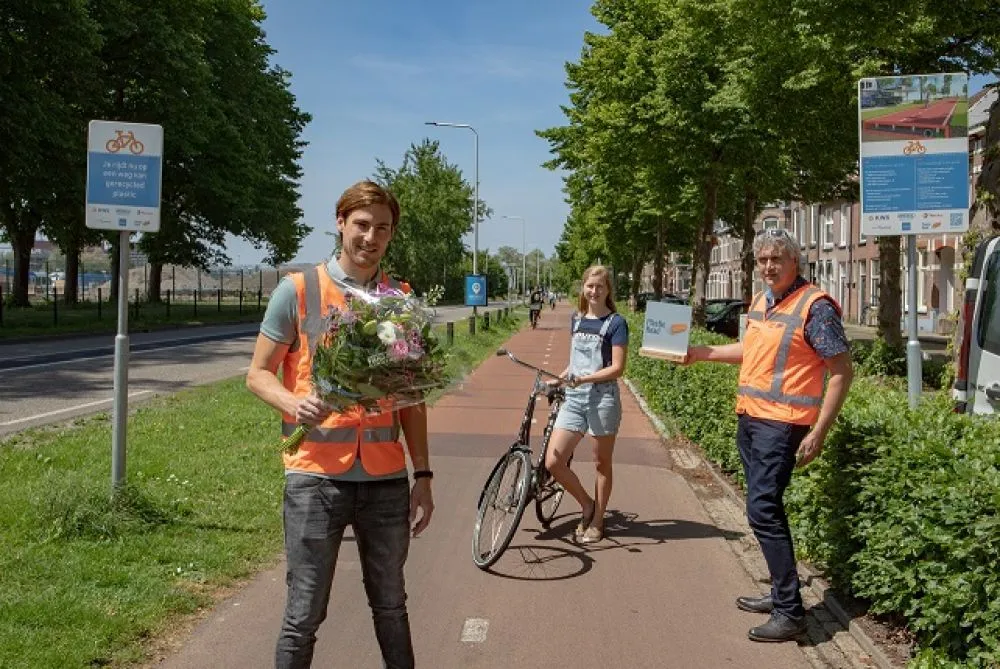
The world’s first plastic surfaced bike path, laid in the Netherlands, has recorded its millionth crossing, according to PlasticRoad, the company that makes the surface.
PlasticRoad – also the name of the product – is made from recycled plastic waste. The company is an initiative of KWS - a VolkerWessels company – as well as Wavin and Total. It said that after one and half years of testing and development into a design suited for industrial production, the technology is ready to be launched on the market. Industrial manufacture of the PlasticRoad will start in the first quarter of 2021.
The results of the two 30m bike path pilot projects in the Netherlands show that it is possible to construct prefabricated roads consisting of recycled plastic waste. Each pilot contains about 1,000kg of recycled plastics, the equivalent of 218,000 plastic cups. The pilot version of the PlasticRoad has cut CO₂ emissions by between 50% and 70% compared to conventional bike paths made from asphalt or concrete slabs, claims the company.
The definite version of PlasticRoad will be more rugged and 2.5 times stronger than the test sections laid in Zwolle and Giethoorn. This makes the PlasticRoad suited for applications like parking lots and the company said it is preparing the first pilot project for this particular application. The company also said that is a step closer to realising the use of PlasticRoad for cars and other road traffic.
The hollow sections under the PlasticRoad’s surface are intended to quickly store sudden precipitation runoff and gradually allow it to infiltrate the subsoil. This climate-adaptive solution turns out to work very well in practice. The highest water level measured within the PlasticRoad was only 48% of the available storage capacity at the Zwolle test site. The water subsequently infiltrates the subsoil within the next two days – as predicted.
The company said it will look at clients in the Netherlands and neighbouring countries, after which they expect to scale up to markets in other parts of the world.