Stabiliser/recycling machines are now well proven in road construction applications, giving a stable base layer on which to lay asphalt layers. A wide variety of technologies have been developed to help optimise this process and one proven road stabilisation product called Pavmax that has been used successfully in various markets including Latin America is now being made available worldwide.
Introduced by NTI Holdings, Pavmax is a proprietary concentrated liquid, with a multi-enzymatic formulation that

Stabiliser/recycling machines are now well proven in road construction applications, giving a stable base layer on which to lay asphalt layers. A wide variety of technologies have been developed to help optimise this process and one proven road stabilisation product called Pavmax that has been used successfully in various markets including Latin America is now being made available worldwide.
Introduced by8893 ELJ Technologies, Pavmax is a proprietary concentrated liquid, with a multi-enzymatic formulation that is intended to alter soil properties. Non-toxic and environmentally safe, the Pavmax product can offer effective road base stabilisation in an array of applications. According to the company, this allows improved methods for building or maintaining roads or highways, with the ability to cut costs by up to 40% compared with earlier generation road construction methods. A key feature of the product is that it is easy to apply, while it also does away with the need for any special equipment. As long as the compaction machines used for a job are used to the required specification, NTI Holdings says that any new or existing roads treated with Pavmax will feature a strong and highly durable base structure that requires less maintenance.
The product is said to lower the surface tension of water, promoting a fast and thorough dispersal of moisture. The company says that this action results in hydrated clay particles filling the voids throughout the solid, forming a tight, dense and permanent layer. By using Pavmax the company claims that required soil density can be achieved with less compaction effort, due to the increased lubricity of the soil particles. This product also helps reduce the quantity of water required during base layer preparation to achieve optimum moisture levels by up to 25%, a key issue on worksites at altitude or in remote areas where a convenient water source may not be readily available. Another cost-saving benefit is that the Pavmax product can reduce the need for hauling fresh aggregate to site, as the existing soil can become the road base as long as there are sufficient cohesive fines present. And for those applications where aggregates are required, lower cost dirty materials (with 15-20% cohesive fines passing a 200 screen) can be used as the dirty fines will help bond the structure together.
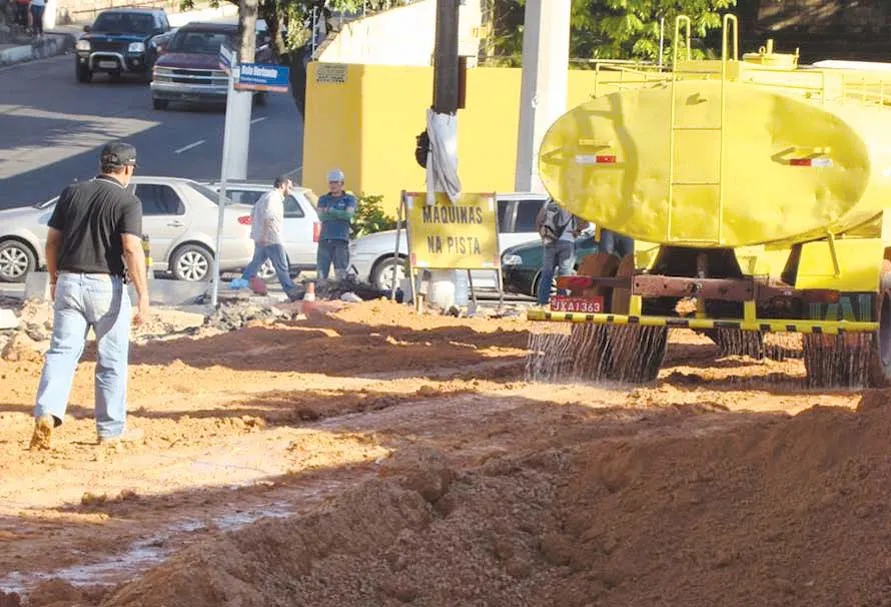
Both new and existing roads can be treated with Pavmax and the product is said to provide a durable structure that will require minimal maintenance. A wide array of applications can be achieved as Pavmax can be used on sites with ambient temperatures from near-freezing up to hot summer. It is highly versatile as it can be used in rainy climates or dry deserts, alongside dykes on mountains or underground. The firm says the product has been well-proven in an array of applications including runway construction, major highways, secondary roads, gravel roads, dirt roads, stabilising large (parking) areas and securing embankments and ditches. In the Brazilian city of Manaus, Pavmax was used to provide a stable base structure during the upgrade of various road links in the run up to the 2014 World Cup held earlier this year, as well as for the upcoming 2016 Olympics.
The Pavmax product is a water-based liquid enzyme in concentrate form that is said to be highly stable, environmentally safe and easy to handle as it is not a skin irritant, is non-corrosive, non-carcinogenic and biodegradable. The firm says however that it is necessary to avoid high temperatures and either high or low pH values when handling the product. As it is water-based, containers that have held the Pavmax product can be washed easily and then recycled for other uses if required.
Introduced by
The product is said to lower the surface tension of water, promoting a fast and thorough dispersal of moisture. The company says that this action results in hydrated clay particles filling the voids throughout the solid, forming a tight, dense and permanent layer. By using Pavmax the company claims that required soil density can be achieved with less compaction effort, due to the increased lubricity of the soil particles. This product also helps reduce the quantity of water required during base layer preparation to achieve optimum moisture levels by up to 25%, a key issue on worksites at altitude or in remote areas where a convenient water source may not be readily available. Another cost-saving benefit is that the Pavmax product can reduce the need for hauling fresh aggregate to site, as the existing soil can become the road base as long as there are sufficient cohesive fines present. And for those applications where aggregates are required, lower cost dirty materials (with 15-20% cohesive fines passing a 200 screen) can be used as the dirty fines will help bond the structure together.
Both new and existing roads can be treated with Pavmax and the product is said to provide a durable structure that will require minimal maintenance. A wide array of applications can be achieved as Pavmax can be used on sites with ambient temperatures from near-freezing up to hot summer. It is highly versatile as it can be used in rainy climates or dry deserts, alongside dykes on mountains or underground. The firm says the product has been well-proven in an array of applications including runway construction, major highways, secondary roads, gravel roads, dirt roads, stabilising large (parking) areas and securing embankments and ditches. In the Brazilian city of Manaus, Pavmax was used to provide a stable base structure during the upgrade of various road links in the run up to the 2014 World Cup held earlier this year, as well as for the upcoming 2016 Olympics.
The Pavmax product is a water-based liquid enzyme in concentrate form that is said to be highly stable, environmentally safe and easy to handle as it is not a skin irritant, is non-corrosive, non-carcinogenic and biodegradable. The firm says however that it is necessary to avoid high temperatures and either high or low pH values when handling the product. As it is water-based, containers that have held the Pavmax product can be washed easily and then recycled for other uses if required.