Peab Asfalt of Sweden primarily handles major road and highway projects in the inland portion of the country, but the company was willing and able to take on a new challenge when an airport runway needed to be paved in its own backyard. The work was done in Jönköping, which has a relatively small airport but which is still crucial to the inland area of Sweden. Flights were typically rerouted during the project, with the exception of two per day in the late afternoon or evening. This enabled Peab Asfalt t

The work was done in Jönköping, which has a relatively small airport but which is still crucial to the inland area of Sweden.
Flights were typically rerouted during the project, with the exception of two per day in the late afternoon or evening. This enabled Peab Asfalt to make progress almost daily, and also kept outbound and inbound passengers and freight connecting to key hubs in the Swedish capital Stockholm and Copenhagen, Denmark.
"Even with the limited flights, we had to adjust paving schedules," said Reijo Seppanen, project superintendent for Peab Asfalt. Paving often started in the middle of the night and extended into the late afternoon of the following day.
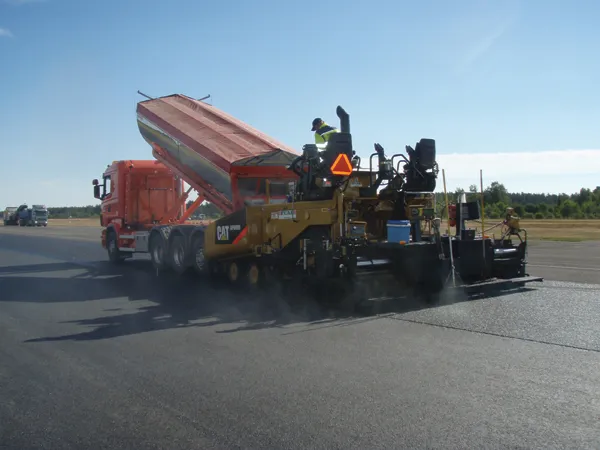
Another contractor handled the first phase of the project, which consisted of milling about 50mm off the existing surface, and then the asphalt was laid. The paving portion of the project took about three weeks with the insulated trucks travelling about 70km from the asphalt plant to the airport.
Segregation is always on the mind of Seppanen and others at the company. The efforts start at the plant, with proper loading of the trucks, which have rounded, not flat- bed, bottoms. This prevents sticking when the materials are end-dumped into the
To help, during the work the traffic was light given the area and the fact that much of the paving was done at night. Shorter truck cycle times, combined with other segregation fighting efforts, paid off.
The mix left the plant at 170º-180ºC and was dumped into the hopper at about 160º-165ºC.
Plant production, paving speed and trucking were all calculated to keep the paver moving at a consistent pace.
"We move continuously. That's one of the key efforts we make to prevent segregation," said Seppanen.
Another segregation-fighting technique is allowing mix to collect in the sides of the hopper throughout the shift.
The Caterpillar AP600D was a newcomer to the site, with the company previously using a different manufacturer's product.
The Cat paver worked at a pace of about 4-5m/minute, placing a single lift of 40mm at a width of 4.5m. Ten passes were required to cover the entire width of the 45m runway.
"The middle of the runway is the highest point because of drainage. We started at one side, then made five passes until we reached the middle. Then we started at the opposite side, and worked our way back to the middle," said Seppanen.
The width of the project led to many longitudinal joints. Peab Asfalt crews placed the new, hot mat slightly higher than the adjacent cold mat. A breakdown compactor used a small side roller to compact the joint.
Three heavy rollers, in the 11tonne range, handled compaction.
The first roller made 6-7 passes, with a movement up being one pass, and the movement back counting as a second pass, while the second roller worked about 50m from the paver. The number of passes varied based on that day's conditions. The compactor was vibrating while making its passes.
The third roller had no set distance between it and the rest of the paving train.
Core samples were taken along the way to ensure adequate compaction was being achieved, and while the project had production and time demands, Peab Asfalt was glad to take it on.
"We don't have many projects like that come up. When there is an opportunity, you have to take advantage of it," said Seppanen, who emphasised the importance of product support for the company's efforts to hit deadlines and overcome other obstacles.
"It's important on time-sensitive jobs like this," said Seppanen.