As powerful fabrics, geosynthetics and geotextiles have a wide range of applications in many civil engineering applications including roads and airfields. Geosynthetics specialist Tensar is introducing a radical new product that it thinks will revolutionise the construction industry. According to the company, its new product represents the "biggest advance in ground stabilisation technology for 25 years. Six years in development, it is said to offer major improvements in aggregate confinement and soil stabi

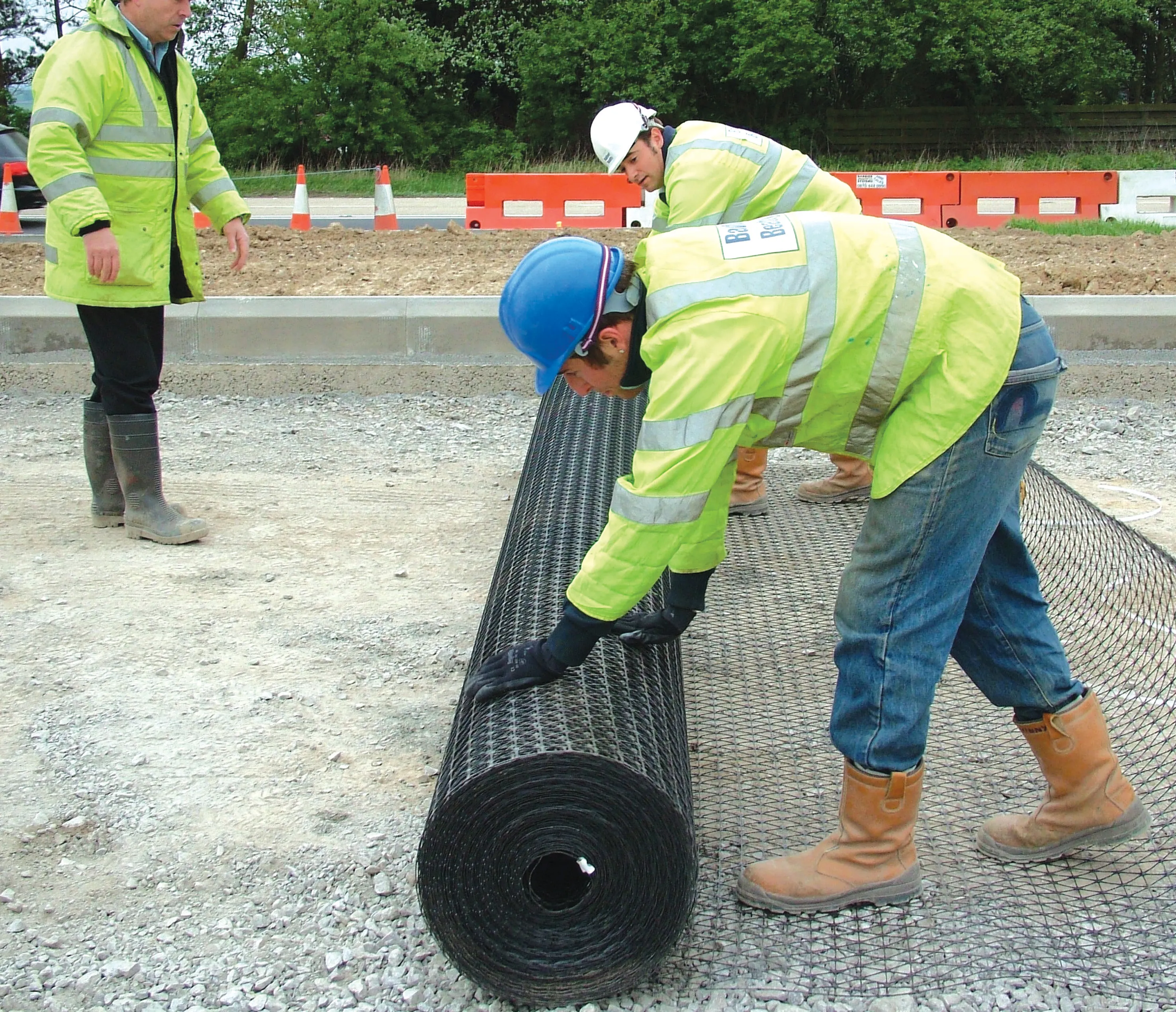
As powerful fabrics, geosynthetics and geotextiles have a wide range of applications in many civil engineering applications including roads and airfields
Geosynthetics specialistAccording to the company, its new product represents the "biggest advance in ground stabilisation technology for 25 years. Six years in development, it is said to offer major improvements in aggregate confinement and soil stabilisation properties.
Tim Oliver, group marketing manager for Tensar said that the new product, TriAx, is based on the equilateral triangle, the most stable geometric shape, providing a marked change from the rectangular or square structures employed on conventional biaxial geogrid products.
Tensar introduced its successful geogrid product some 30 years ago and since then it has become a leader in the market, but while it has a quality product range it is faced with increasingly tough competition in the geosynthetics market, with an increasing number of players entering the sector.
Oliver claims that some rivals have been tempting customers with lower cost products, and Tensar was looking to take the next step so it could stay ahead of its competitors.
So the team in Tensar became focussed on a single question: "How could we make the product better?" The answer came when a new employee from the automobile industry joined Tensar, and told the company: "You need a different structure." The engineer suggested a triangular grid, which is widely used in other industries, and once this basic idea had been proposed, considerable research was carried out to fine tune the design.
"We found that the rib shape is important, it needs to be slightly concave," said Oliver.
The interlock between the geogrid and the aggregate is crucial in sub-base construction and put basically, the stones fall in between the holes in the grid, holding it in place. To ensure the grid performs well in this respect requires the rib thickness to be optimised: big enough to provide sufficient strength yet small enough to allow good interlocking with the aggregate. The junction points where the ribs meet are also crucial areas, providing sufficient strength to transfer the loads.
Trials carried out so far show that TriAx offers better load distribution capabilities due to the increased stiffness and aggregate confinement it provides. A wide range of different tests were carried out on TriAx at Nottingham University in the UK as well as at the UK's Transport Research Laboratory (TRL) and
Different rib sizes and apertures were tried at the university to help understand the performance of the new product and optimise the design. At the TRL, comparison tests were carried out with the best of the conventional biaxial Geogrid types. Meanwhile, tests at the BRE showed that the TriAx actually distributes its load more evenly and over a wider area than conventional products.
Oliver explained that this extensive research shows that the TriAx product offers uniform stiffness in an array of different directions. He said: "For a given number of passes you have less deformation. What that means is you can reduce the amount of aggregate you need." This provides a major cost saving in materials needs for a construction project using TriAx, and Oliver said that further cost savings can be made in other areas of a project, for example reducing the amount of earthmoving and excavation.
Every construction project is different and geogrids can be used in numerous ways. Applications include use in steep embankments and using geogrid layers to stabilise the slopes and provide permanents reinforcement.
These products are often used in sub-base to reduce the amount of aggregate needed when building unpaved roads or permanently paved roadways. Because there is such an array of possible applications, specifying the saving TriAx can deliver is next to impossible. But Oliver believes that using TriAx will make a major impact on the overall cost of a project.
He said that for a capping layer application for example: "We worked out that the saving by putting in TriAx can be up to 13%." Another major advantage to the contractor installing this type of grid is that there is no need to orientate it in a specific way and this allows more freedom for a project's designer, according to Oliver.
Tensar is now talking with several major consultants and tendering contractors, explaining the advantages of the new product.
Although it is brand new, the product is already being used on its first major highway project, the A66 upgrade in the UK. Consultant WS
Oliver said that the original design called for the use of a conventional biaxial product but that the project team decided to opt for the innovative TriAx system instead, because of the benefits it offered.
Unusually, the price of the TriAx is slightly lower than that of the product it is taking over from and Oliver said: "We see this replacing our biaxial geogrids." The introduction of TriAX comes at a time when Tensar is in a stronger position internationally. Its businesses in the US and Europe have now been brought together as part of the same company following the purchase by the present owner, a group of private investment backers.
Tensar is now gearing up to change over its production processes for TriAx, with the product already being manufactured at its new facility in China. Although this is the smallest of Tensar's three factories, the output will be sufficient to launch TriAx in the UK market, with the world launch due early in 2008.
The company is planning to switch over production at its UK facility to making TriAx next, And it will then be able to start manufacturing the product at its US plant.
Tensar is confident that TriAx will give it a major lead over its rivals, and Oliver added that the competition will find this difficult to replicate.
"It's a real challenge to manufacture"