Swarco signs for slower Swansea speed limit

In March, the Welsh government passed a law which from September will see the default speed limit on restricted roads in Wales reduced from 30mph (50kph) to 20mph (32kph).
By David Arminas June 30, 2023 Read time: 2 mins
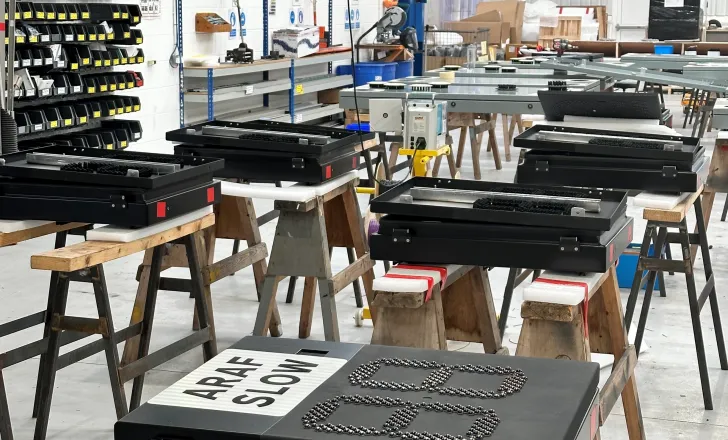
The signs are all being manufactured and rigorously tested at Swarco’s factory in Melsonby in the English county of North Yorkshire (image courtesy Swarco UK & Ireland)

Swarco has signed an agreement with the Welsh city of Swansea to design and install signage to support the new 32kph (20mph) urban speed limit.
 
In March, the Welsh government passed a law which from September will see the default speed limit on restricted roads in Wales reduced from 30mph (50kph) to 20mph. To support the upcoming changes to the speed limit, local authorities in Wales are working to make the necessary alterations to existing highway signage to ensure drivers are aware of the changes.
 
Following an open competitive tender process on Sell2Wales in late 2022, Swansea Council entered into a commercial contract with Swarco to replace its existing vehicle speed activated signs (VAS) with new electronic sign units that dynamically display the approaching vehicle’s actual speed. These signs will display the vehicle speed in ‘GREEN’ if the vehicle is complying with the new default speed limit and in ‘RED’ if not. This new contract is designed to work in co-ordination with an existing service and maintenance contract which was already in place.
 
The new agreement will see Swarco install 120 bespoke vehicle activated signs throughout Swansea. The signs, which are all manufactured and rigorously tested at Swarco’s factory in Melsonby in the English county of North Yorkshire, feature Swarco’s EPIX lens technology system to ensure the lowest power consumption.
 
The signs use a radar to detect vehicle speeds and use an energy efficient LED display to clearly show messages to oncoming drivers, as well as being equipped with highly intelligent internal data logging, which is stored within the signs, to provide statistical feedback and data on the number of activations, vehicle speeds and volumes. The council will be able to easily monitor changing driver behaviour.
 
“We are pleased to further extend our working relationship with Swansea Council,” said Derek Williamson, business development manager at Swarco UK & Ireland. “We have worked closely with them to fully understand their requirements and have designed a high quality, reliable, durable and energy efficient solution that delivers a low lifetime cost.”

For more information on companies in this article

Related Content

  • New ice detection technology for motorists
    January 23, 2013
    A new technology developed by the VTT Technical Research Centre of Finland provides drivers with warnings of black ice on the roads. This automatic detection system will warn a driver in advance that a road is dangerous due to the presence of ice. According to VTT, this uses a novel, real-time method of obtaining information on road surface friction and employs data collected from the car’s in-built sensors. This compares the speeds of the drive shafts and axles in an array of driving conditions, with an al
  • Infrastructure stays strong on the road to recovery
    July 1, 2021
    After more than a year of uncertainty, the road industry is coming back stronger than ever before thanks to new ways of working and increased investment – because building new infrastructure lays the foundation for a more resilient and economically robust world.
  • Napier University and RPS study looks at UK cycle lanes
    January 9, 2015
    A new UK report suggests local authorities should think twice about automatically incorporating cycle lanes in road design. David Arminas reports Environmental and social arguments for getting more people onto bicycles are well known. The theory is the more people cycling, the less traffic congestion and less air pollution from cars. Well-defined cycle lanes can encourage people who might otherwise be too nervous to take to a bicycle. But just how effective are cycle lanes for increasing the safety of
  • Safety trials for FORUM8 cycle simulator
    August 17, 2020
    Research by Morgan State University in the US using linked up driving and cycling simulators could help with safer urban road designs for both drivers and cyclists.