With the aid of services provided by Laidler Associates the refurbished Portumna road bridge in Galway has become the first bridge in the Ireland to carry European CE marking. The CE marking was needed because the swing bridge has moving parts, and falls within the scope of the Machinery Directive.

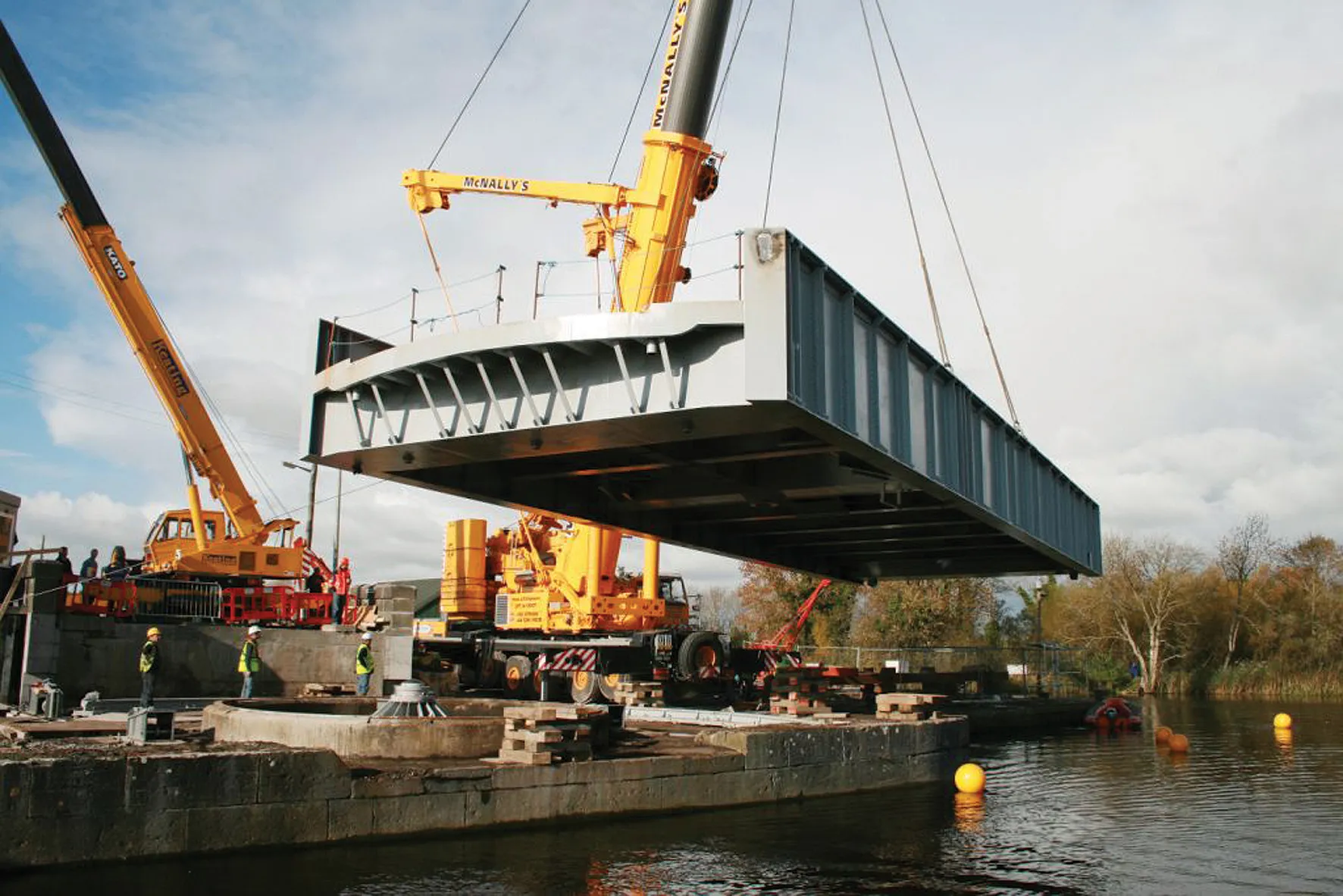
With the aid of services provided by 1398 Laidler Associates the refurbished Portumna road bridge in Galway has become the first bridge in the Ireland to carry European CE marking.
The CE marking was needed because the swing bridge has moving parts, and falls within the scope of the Machinery Directive.
Spanning the Shannon River, the E2.2 million Portumna Bridge was originally built in 1911 and is part of the busy N65 route that links the counties of Galway and Tipperary.
When it was decided that this ageing but vital structure needed to be refurbished, Waterways Ireland awarded the order for design specification, contract preparation and project supervision to Royal Haskoning, who appointed L&M Keating to carry out the building and installation work.
Royal Haskoning recommended that Laidler Associates should be used to provide the consultancy services needed to ensure that the bridge met all relevant legal requirements and, in particular the requirements for CE marking. After these preliminary sessions, Laidler Associates carried out detailed hazard assessments covering all aspects of the bridge design and construction. Consultants from the company also visited the site during the construction work and, when the work was complete, they carried out a detailed final inspection before certifying the structure.
Jane Arbuckle, technical director, mechanical and electrical engineering at Royal Haskoning, said: "The regulatory compliance and certification work carried out for us by Laidler Associates went very smoothly."
The CE marking was needed because the swing bridge has moving parts, and falls within the scope of the Machinery Directive.
Spanning the Shannon River, the E2.2 million Portumna Bridge was originally built in 1911 and is part of the busy N65 route that links the counties of Galway and Tipperary.
When it was decided that this ageing but vital structure needed to be refurbished, Waterways Ireland awarded the order for design specification, contract preparation and project supervision to Royal Haskoning, who appointed L&M Keating to carry out the building and installation work.
Royal Haskoning recommended that Laidler Associates should be used to provide the consultancy services needed to ensure that the bridge met all relevant legal requirements and, in particular the requirements for CE marking. After these preliminary sessions, Laidler Associates carried out detailed hazard assessments covering all aspects of the bridge design and construction. Consultants from the company also visited the site during the construction work and, when the work was complete, they carried out a detailed final inspection before certifying the structure.
Jane Arbuckle, technical director, mechanical and electrical engineering at Royal Haskoning, said: "The regulatory compliance and certification work carried out for us by Laidler Associates went very smoothly."