Doka’s SKE50 automatic climbing formwork are being used on two suspension towers for a new multi-lane cable-stayed bridge alongside an older viaduct in Zaporozhye, south-east Ukraine. On completion, this large-scale infrastructure project is set to massively reduce the traffic burden on the existing bridge and significantly improve the daily traffic situation at what is a major river crossing. The two separate roadway slabs are cable-stayed off twin H-shaped suspension towers 150metres high. Lead project co

On completion, this large-scale infrastructure project is set to massively reduce the traffic burden on the existing bridge and significantly improve the daily traffic situation at what is a major river crossing. The two separate roadway slabs are cable-stayed off twin H-shaped suspension towers 150metres high. Lead project contractor Mostobud are said to have chosen Doka for its smooth cooperation on previous builds, topped by what it saw as the firm’s acclaimed competence on technologically challenging automatic climbing projects.
For the sake of strength, the two suspension towers are of solid cross-section to the full height of the first two concreting sections. The section is hollow from the 11metre level up. Per tower leg there are eight SKE50 automatic climbers carrying 100 m² of Doka Top 50 beam formwork, plus a set of Doka shaft formwork, repositioned with a single lift of the crane.
“The Doka formwork has proved the perfect solution for building the two suspension towers quickly and economically,” says project manager Volodymyr Klymenko.
Up to where the cross-beam ties in at the sixth concreting section, the legs of the towers are inclined at an angle of 5.3° off the vertical. Above that beam level, the tower legs are climbed at an angle of 5.6°. The polygonal cross-section tapers 5cms per concreting section. Aggregated over the total of 40 concreting sections, that equates to a difference of 2metres between the first and last sections in the towers’ tapering cross-section.
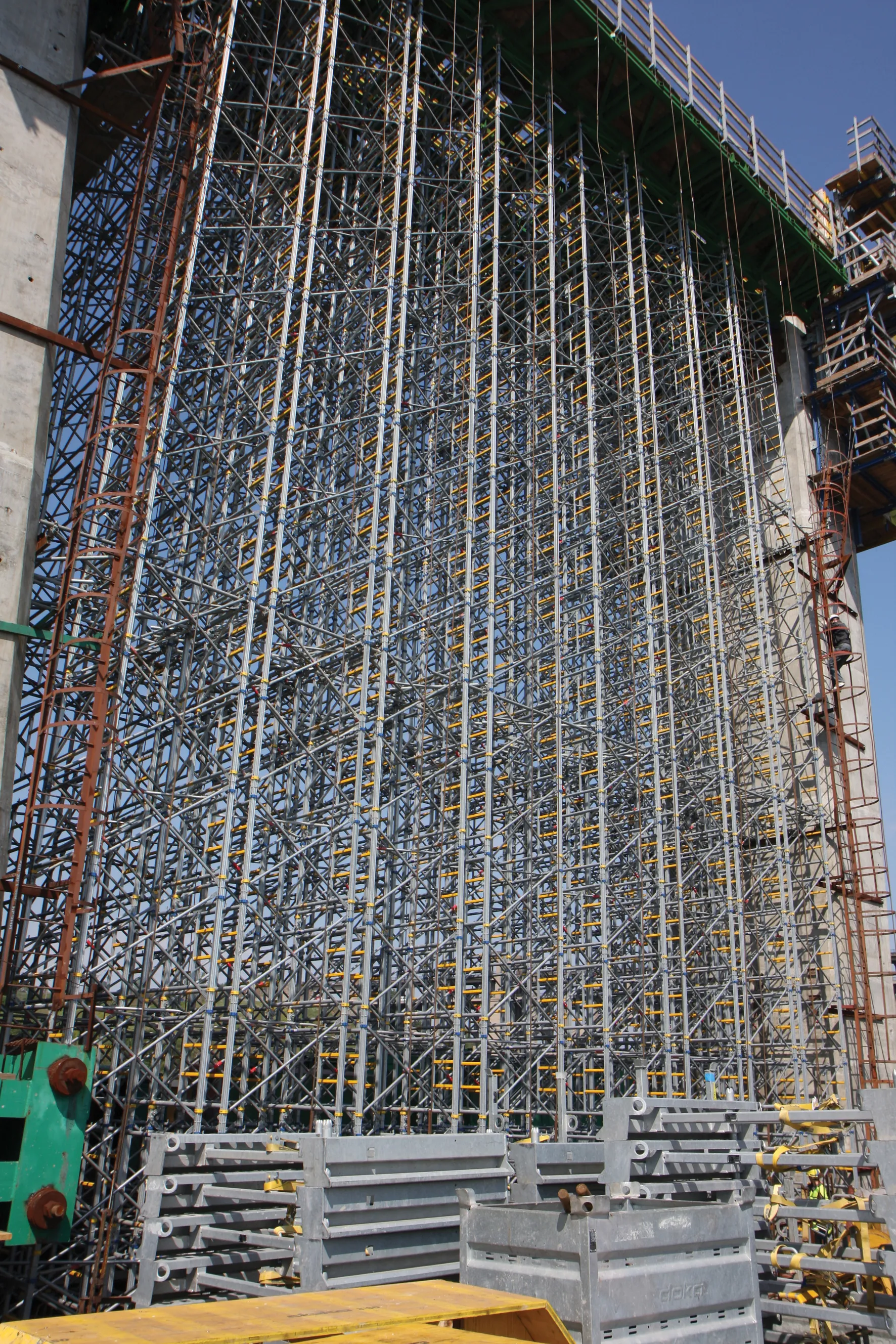
The hollow-section cross-beam is 6metres high and 20metres long to carry the roadway slab and is formed with Doka Top 50 large area formwork. This formwork is supported at a height of around 25metres by easy-to-use, easily erected Staxo 100 load-bearing towers. The integrated ladderways and a multiplicity of attachment options for personal protective equipment are said to enable the falsework towers to be erected rapidly, yet also in total safety. Starting from the top surface of the cross-beam, the automatic climbing platforms are set to the new angle of 5.6° from the vertical. A catwalk, suspended from the self-climbing system, forms another connecting link between the two legs of the tower. The walkway means that per tower, one passenger hoist is enough to bring the crew to their workplaces. The catwalk is said to be a special solution developed specifically for the build by Doka.