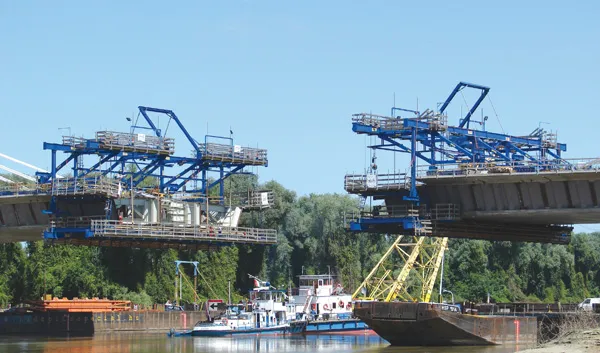
When the Queensferry Crossing over the Forth Estuary opens at the end of 2016, it will be the third landmark bridge to be built spanning this short stretch of water. This 2.7km structure is lying alongside the existing road bridge and the historic rail bridge and is the centrepiece of the upgrade to Scotland’s key cross-Forth transport corridor.
Responsible for the construction is Forth Crossing Bridge Constructors – FCBC, a consortium of companies from Germany, Spain, the US and the UK.
Construction

When the Queensferry Crossing over the Forth Estuary opens at the end of 2016, it will be the third landmark bridge to be built spanning this short stretch of water. This 2.7km structure is lying alongside the existing road bridge and the historic rail bridge and is the centrepiece of the upgrade to Scotland’s key cross-Forth transport corridor.
Responsible for the construction is Forth Crossing Bridge Constructors – FCBC, a consortium of companies from Germany, Spain, the US and the UK.
Construction work will take place 207m above sea level. Around 150,000tonnes of concrete will be poured and more than 37,000km of cabling will be used.
Also used will be four DF16 rebar tiers and 377,000 ties from1651 Wacker Neuson. The DF16s tie “shear links” on rebar on the deck section of the bridge. Steel required for the final deck weighs 35,000tonnes - the equivalent weight of nearly 200 Boeing 747s.
“Thanks to the upright position of the DF16, work is now much more back-friendly,” explained John Rodgers, FCBC works manager. The mechanical device uses a proven twin-wire mechanism which ties up to 1,000 uniform and firm knots per hour.
Steelworkers are making 33,000 ties per section with the mechanical tier. The operator is independent of a battery and the necessary charging time. In addition, no scrap wire is produced which must be removed at the end of the work.
To compact the fresh concrete John and his team use 40 high-frequency internal vibrators of the IFRU series. “We use two different variants of the vibrator head size, 57mm and 38mm,” said Rodgers. They can be simply connected to the 1-phase power supply and are ready for operation.
Models in the IRFU series have an integrated frequency converter. No additional frequency converters are needed to operate this internal vibrator. Simply connect to a plug receptacle. Also in conjunction with a generator and with fluctuating input voltages IRFU is safe and reliable. Thanks to the complete potted electronic components, there is no danger of an electric shock.
Responsible for the construction is Forth Crossing Bridge Constructors – FCBC, a consortium of companies from Germany, Spain, the US and the UK.
Construction work will take place 207m above sea level. Around 150,000tonnes of concrete will be poured and more than 37,000km of cabling will be used.
Also used will be four DF16 rebar tiers and 377,000 ties from
“Thanks to the upright position of the DF16, work is now much more back-friendly,” explained John Rodgers, FCBC works manager. The mechanical device uses a proven twin-wire mechanism which ties up to 1,000 uniform and firm knots per hour.
Steelworkers are making 33,000 ties per section with the mechanical tier. The operator is independent of a battery and the necessary charging time. In addition, no scrap wire is produced which must be removed at the end of the work.
To compact the fresh concrete John and his team use 40 high-frequency internal vibrators of the IFRU series. “We use two different variants of the vibrator head size, 57mm and 38mm,” said Rodgers. They can be simply connected to the 1-phase power supply and are ready for operation.
Models in the IRFU series have an integrated frequency converter. No additional frequency converters are needed to operate this internal vibrator. Simply connect to a plug receptacle. Also in conjunction with a generator and with fluctuating input voltages IRFU is safe and reliable. Thanks to the complete potted electronic components, there is no danger of an electric shock.