The first agreements for Amsterdam’s proposed underground highway have now been reached. These have been made by the Dutch Minister for the Environment and Transport as well as Amsterdam local authority and the province of North-Holland.
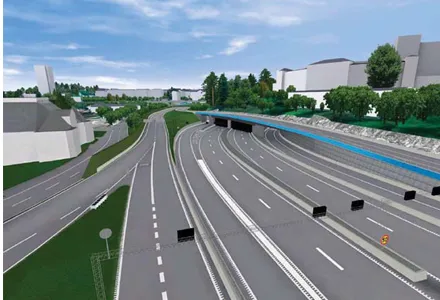
Under the agreed terms, the A10 highway will feature 12 lanes of traffic in four 1.2km tunnels under the capital, Amsterdam. The project will also include building metro and rail lines underground.

he first agreements for Amsterdam’s proposed underground highway have now been reached. These have been made by the 1346 Dutch Minister for the Environment and Transport as well as Amsterdam local authority and the province of North-Holland.
Under the agreed terms, the A10 highway will feature 12 lanes of traffic in four 1.2km tunnels under the capital, Amsterdam. The project will also include building metro and rail lines underground.
The highway and rail lines form a 150m barrier at present in between Amsterdam and the suburb of Buitenveldert. Amsterdam has been campaigning for a number of years to have the highway and rail lines slotted underground to pave the way for building and general development above. Two new proposals have been made that would feature four tunnels side-by-side rather than a more-expensive two-tier system. These would allow rail and metro lines to be placed in five tunnels above the highway, reducing the estimated cost to e1.74 billion, of which the government would provide e775 million. Using the newly released land could generate e1.165 billion, a profit of up to e199 million and putting the project on a sound economic foundation. If final approval is given in 2010, construction of the highway could be complete in 2016.
However, a report into the proposed road tunnel under Rijnstrangen in the Netherlands suggests that the project would exceed the budget. The report was carried out by consultancy firm Strukton, which has released the information to the authorities in Zevenaar, Groessen and Duiven that an 8km road tunnel under the Rijnstrangen green area is possible, but that construction alone would cost e1.2 billion, considerably more than the e750 million budgeted for the work. Local communities propose that the A15 be extended to meet the A18 in a bid to ease congestion in the region, but the notion has been knocked back by the Transport Ministry due to concerns over sustainability. Central government prefers a solution via the A12, which would impact the Groessen community.
Meanwhile the contract for the fast-track project B has been awarded to1348 VolkerInfra, Combinatie 1349 Van Hattum en Blankevoort, 1350 KWS INfra, 1355 Boskalis and 1357 Hollandia. The contract concerns the widening and relocation of the N50 national road between Rampsol and Ens. The new road is to open in spring 2013.
Under the agreed terms, the A10 highway will feature 12 lanes of traffic in four 1.2km tunnels under the capital, Amsterdam. The project will also include building metro and rail lines underground.
The highway and rail lines form a 150m barrier at present in between Amsterdam and the suburb of Buitenveldert. Amsterdam has been campaigning for a number of years to have the highway and rail lines slotted underground to pave the way for building and general development above. Two new proposals have been made that would feature four tunnels side-by-side rather than a more-expensive two-tier system. These would allow rail and metro lines to be placed in five tunnels above the highway, reducing the estimated cost to e1.74 billion, of which the government would provide e775 million. Using the newly released land could generate e1.165 billion, a profit of up to e199 million and putting the project on a sound economic foundation. If final approval is given in 2010, construction of the highway could be complete in 2016.
However, a report into the proposed road tunnel under Rijnstrangen in the Netherlands suggests that the project would exceed the budget. The report was carried out by consultancy firm Strukton, which has released the information to the authorities in Zevenaar, Groessen and Duiven that an 8km road tunnel under the Rijnstrangen green area is possible, but that construction alone would cost e1.2 billion, considerably more than the e750 million budgeted for the work. Local communities propose that the A15 be extended to meet the A18 in a bid to ease congestion in the region, but the notion has been knocked back by the Transport Ministry due to concerns over sustainability. Central government prefers a solution via the A12, which would impact the Groessen community.
Meanwhile the contract for the fast-track project B has been awarded to