High speed bridge demolition minimises disruption

A high speed bridge demolition project has been carried out successfully in Germany. Speed was of the essence as the bridge spanned an important road link and had to be removed in a tight time frame, minimising disruption to traffic.
April 13, 2012 Read time: 3 mins
Atlas Copco hydraulic equipment performed reliably during a 30 hour project to remove an old road bridge in southern Germany

A high speed bridge demolition project has been carried out successfully in Germany. Speed was of the essence as the bridge spanned an important road link and had to be removed in a tight time frame, minimising disruption to traffic.

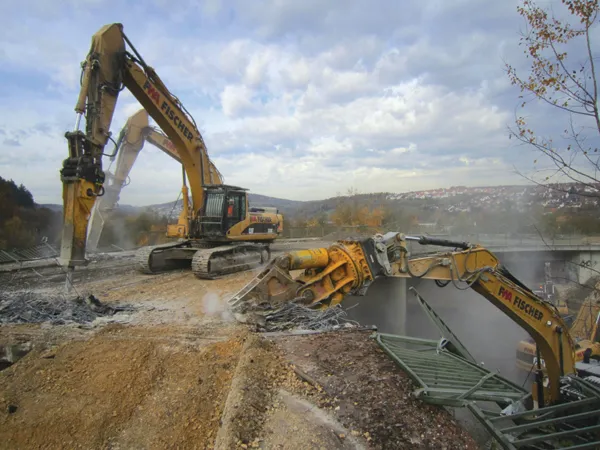
The job formed part of a project for a new layout of the junction of the roads B297 and B29 close to Lorch in southern Germany. FWA Fischer Weilheim Abbruch was brought in by the Stuttgart Regional Council to demolish the old bridge carrying the B297 over the B29. The two-bay bridge structure was made of reinforced concrete and weighed 3,000 tonnes. During demolition work, damage caused to the closed section of Federal road had to be avoided at all cost.

The demolition job turned out to be difficult because the bridge not only featured a longitudinal and transverse slope, but also had a curve at a 280m radius to the horizontal. Slightly offset and some 15m below the bridge, a passage for local residents' vehicles had to be always accessible for rescue vehicles during the entire demolition period.

The only way to carry out the job was for the demolition to be undertaken during a set period when the roads could be closed, to minimise disruption and maximise safety.

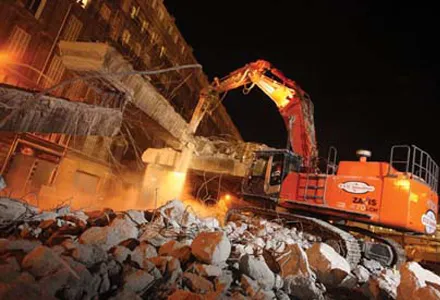
Work started with the full closure of the roads, the removal of the crash barriers and the protection of the Federal road B29 using an impact bed made of material for subsequent recycling. This was followed by the demolition of the bridge carried out by the fleet of 178 Caterpillar machines consisting of a wheeled excavator and five crawler excavators equipped with hydraulic breakers and CombiCutters.

For its attachments FWA 2777 Fischer Weilheim used 161 Atlas Copco tools; a total of five model HB3000, HB4200 and HB7000 heavy hydraulic breakers which were supported by four model CC3300U, CC3300S and CC6000U CombiCutters.

As the two HB3000 hammers were breaking down the 300mm thick deck slab from above, the two CC3300U and the CC6000U CombiCutters started to reduce the bridge caps. Then the bottom chords with a cross sectional area of 4m2 of concrete were demolished by the two HB4200 hydraulic breakers and the HB 7000. Once the longitudinal reinforcements were accessible, they were cut by the CC3300S into lengths suitable for removal.

Once the entire bridge bay had been demolished, the CC6000U CombiCutter used its force and its 1.4m wide jaw to demolish the bridge abutments. The use of this large CombiCutter allowed the demolishers from Weilheim to tear down without major effort the one metre wide and heavily reinforced wing walls of the abutment. Afterwards the 7tonne hydraulic breaker was used to reduce the abutment to the ground.

According to the contractor the availability of the hydraulic tools more than met requirements. All five hydraulic attachments worked non-stop for 30 hours without problems.

Once the demolition work was complete the concrete was recycled on site for use in other road construction projects.
For more information on companies in this article

Related Content

  • Flyover replacement
    February 22, 2012
    French contractor DSD Démolition was one of three firms that worked on the recent demolition of the A55 highway flyover in Marseilles, France. The 20-year-old flyover stood near the harbour and formed part of a main route through Marseille leading to Lyon and Avignon. However, it was an ugly structure and spoiled the city's landscape so as part of the wider regeneration taking part in Marseille's harbour, the 1.3km bridge had to be demolished within three months. DSD Démolition had two operators for each of
  • Managing urban motorway complexity in Sydney
    October 4, 2012
    Sydney’s Hills M2 motorway is being widened while still carrying traffic and meeting tough environmental criteria More than 100,000 vehicles and over 27,000 bus commuters use the Hills M2 motorway on a typical workday, making it one of Sydney’s busiest motorway corridors. Owned and managed by Hills Motorway Ltd (HML) and a key part of the city’s orbital motorway network, the road stretches over 21km, providing a seamless link between the Lane Cove Tunnel and Westlink M7. The Hills M2 Upgrade is one of many
  • Busy UK motorway junction demolished in tight time frame – Mark Anthony reports
    October 18, 2012
    Military-style planning and overwhelming demolition firepower ensured that Armac Group avoided financial penalties and the wrath of drivers on one of the UK’s busiest motorway intersections. Demolition & Dismantling reports. 6 January is traditionally known for the visit of the three wise men to Bethlehem. However, on 6 January 2012, three wise demolition engineers from Armac Group was tasked with dismantling the monumental structure known as Catthorpe Viaduct: the main overbridge of the M6/M1/A14 interc
  • Asphalt milling optimised by 3D controls
    February 20, 2012
    3D machine controls can optimise milling efficiency, Mike Woof reports. More efficient milling and recycling operations can be carried out by using the latest 3D control systems on the market. At the last Trimble Dimensions event in Las Vegas, the advantages of 3D controls for milling operations proved a key topic. The use of 3D control systems can offer huge advantages in milling operations. This technology helps increase productivity as the milling machine will only remove what is required, which also hel