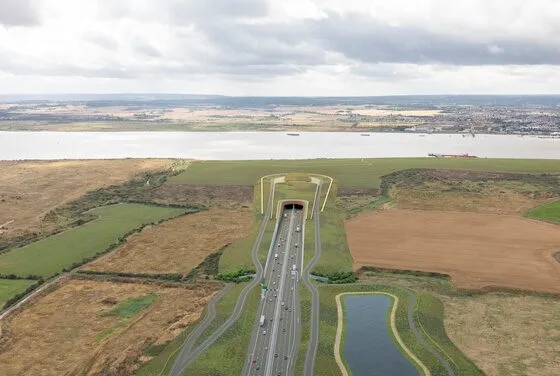

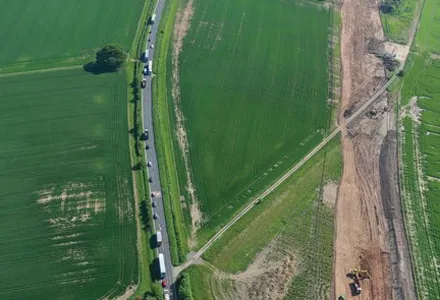
Work is well underway on turning a busy just over 11km two-lane link road from the city of Nottingham to Junction 24 of the M1 in Leicestershire, England into a four-lane highway. The widened highway will relieve considerable peak-time congestion for travellers to Nottingham, the M1 and East Midlands Airport while also making journeys safer and more reliable. Guy Woodford reports
Used by up to 30,000 vehicles a day, the A453 is renowned for congestion at peak travel times. But years of day-to-day commuter and other traveller frustration are coming to an end.
Following a €175.78 million (£150 million) investment, including more than €23 million from
The overall widening works include an 8.85km rural stretch of the A453 from the M1 Junction 24 to the new Mill Hill roundabout at the edge of Clifton. And a 2.41km urban section from the new Mill Hill roundabout to the A52 east of Clifton, built on the existing highway alignment. Traffic lights will be provided at the existing Crusader Roundabout, new roundabouts at Green Lane and Farnbrough Road, and there will be improved access to Nottingham Trent University’s Clifton campus.
As well as cutting congestion and improving journey time reliability, the widened A453 will improve access to East Midlands Parkway train station, and the Enterprise Zone in Beeston.
A series of public information exhibitions have taken place in communities along or near the works route, including Clifton and Kegworth, generating useful feedback for project managers and chief works contractor, Laing O’Rourke.
The A453 widening is one of six schemes to boost growth announced in the Chancellor’s 2011 Autumn Statement and the first to start work. The growth schemes are part of a €3.86 billion investment in large road improvements during the current UK government spending review period (to 2014/15).
On the start of the A453 works last year [2013], Roads Minister Stephen Hammond said, “Upgrading and widening the A453 demonstrates the Government’s commitment to improving our road network and helping to stimulate growth.
“Extra capacity on the road will deliver significant economic benefits for both local businesses and motorists while helping to improve road safety.”
Nottinghamshire County Council Conservative Opposition Group leader, Councillor Kay Cutts, who was leader of the council at the start of the construction phase of the A453 project, has also stressed the “huge benefits” that a widened A453 will bring to the Nottinghamshire economy and the East Midlands region of England as a whole.
“Nottinghamshire County Council and the local business community campaigned long and hard for its improvement, with the County Council itself putting £20 million into the scheme,” she said in January 2013. “News that work is now starting is fantastic news for everyone in Nottinghamshire.”
Construction uncovers history
A late Iron Age/early Roman settlement has been uncovered during archaeological digs along the A453 widening route.
The finds were made as part of a five-week pre-construction survey by contractors Wessex Archaeology and include the footprint of a stone building, human remains, animal bones, pottery and a jet bracelet.
The site began with a late Iron Age enclosure ditch and settlement, and continued in use into the Roman period and dates from the 1st century BC to the 3rd century AD.
Other evidence that the site covered both eras was the discovery of human remains.
One individual was buried in a crouched position and is likely to be Iron Age in date. An individual in a second grave had been buried in the extended position, which was usually a Roman ritual.
The graves were greatly damaged through ploughing, and a jet bracelet found in a shallow pit may have lain in the base of another ploughed out grave.
The dig, which ended in early October 2012, was carried out alongside other advance work for the widening scheme.
Of the intriguing historic find, Highways Agency senior project manager Iftikhar Mir said, “While widening the existing A453 is all about planning for the future, it’s important that we also consider the past which is why archaeological work is an integral part of what we do at the Highways Agency.
“It is important that the area’s history is recorded and preserved to help inform future generations.”
Wessex Archaeology project manager Andy Norton added, “The finds from our work tell us that farming has taken place on this site for over 2,000 years. The site was home to a farmstead that lasted for several generations and was home to ordinary Romano-British people. It is fascinating that we have found the graves of two of the people that lived here.”
The bones were due to be donated to a local museum or reburied once on the completion of investigations.