Bauer and Europe’s deepest underground parking garage

BAUER Funderingstechniek has constructed an underwater concrete base for Europe's deepest parking garage in Leiden, a university city in the Dutch province of South Holland. Leiden is known for being the birthplace of Rembrandt. The Lammermarkt is an area with a park in the city centre and is used for festivals and events. In addition, the picturesque "Molen de Valk", also known as "The Falcon" is located here. It is a stone windmill that was built in 1785 and is now one of the distinctive sights of the
July 7, 2016 Read time: 2 mins
Bauer digs deep in Leiden
8350 BAUER Funderingstechniek has constructed an underwater concrete base for Europe's deepest parking garage in Leiden, a university city in the Dutch province of South Holland.

Leiden is known for being the birthplace of Rembrandt. The Lammermarkt is an area with a park in the city centre and is used for festivals and events. In addition, the picturesque "Molen de Valk", also known as "The Falcon" is located here. It is a stone windmill that was built in 1785 and is now one of the distinctive sights of the city.
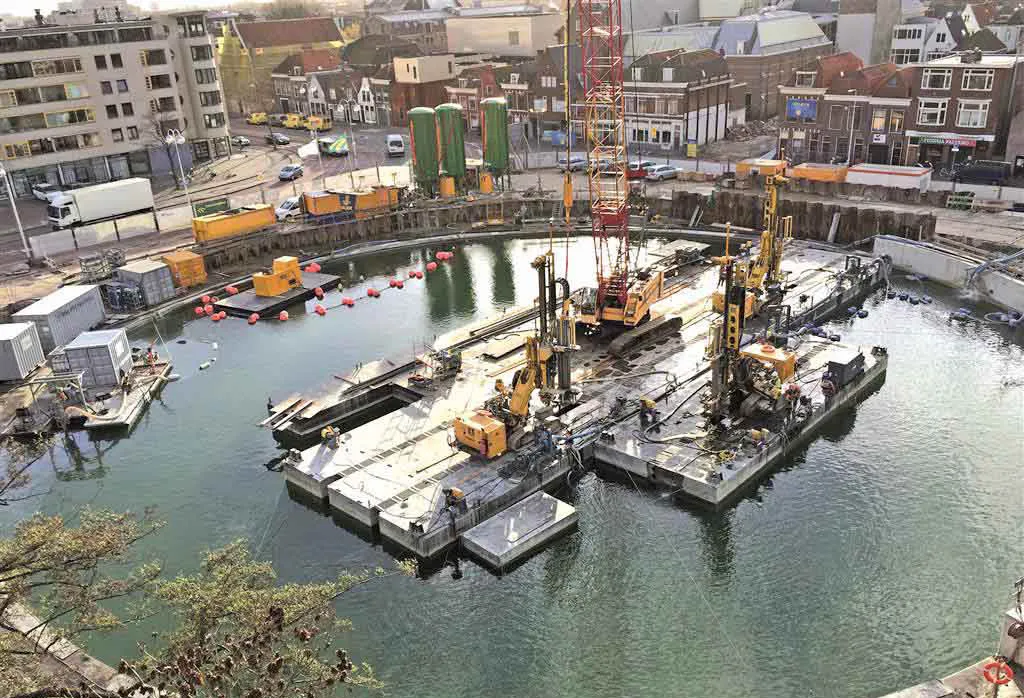
An underground parking garage is being built under the Lammermarkt. With a depth of 22m, it will be the deepest underground parking garage in the entire EU.

BAUER Funderingstechniek, the Dutch subsidiary of BAUER Spezialtiefbau and based in Mijdrecht, constructed an underwater concrete base with 585 GEWI piles. Work was done on behalf of Belgian infrastructure group 1303 BESIX and the Dutch infrastructure group Dura Vermeer.

Drilling has been carried out to a depth of 55m. Three small-diameter drilling rigs on pontoons from 8454 KLEMM Bohrtechnik were used for this. KLEMM Bohrtechnik specialises in the development of high-quality and high-performance drilling equipment with a total weight up to 32tonnes.

In addition, Bauer pumped away and de-sanded the drilling fluid under water. Work was completed last November. The underground parking garage with its 525 parking spaces will be completely finished by 2017.

The BAUER Group, with 110 subsidiaries, provides services, equipment and products dealing with ground and groundwater. It was founded in 1790 and is based in Germany’s Schrobenhausen region, Bavaria. In 2015, it employed about 10,700 people in around 70 countries and achieved total group revenues of €1.66 billion.
For more information on companies in this article

Related Content

  • New Holland 'space savers'
    February 15, 2012
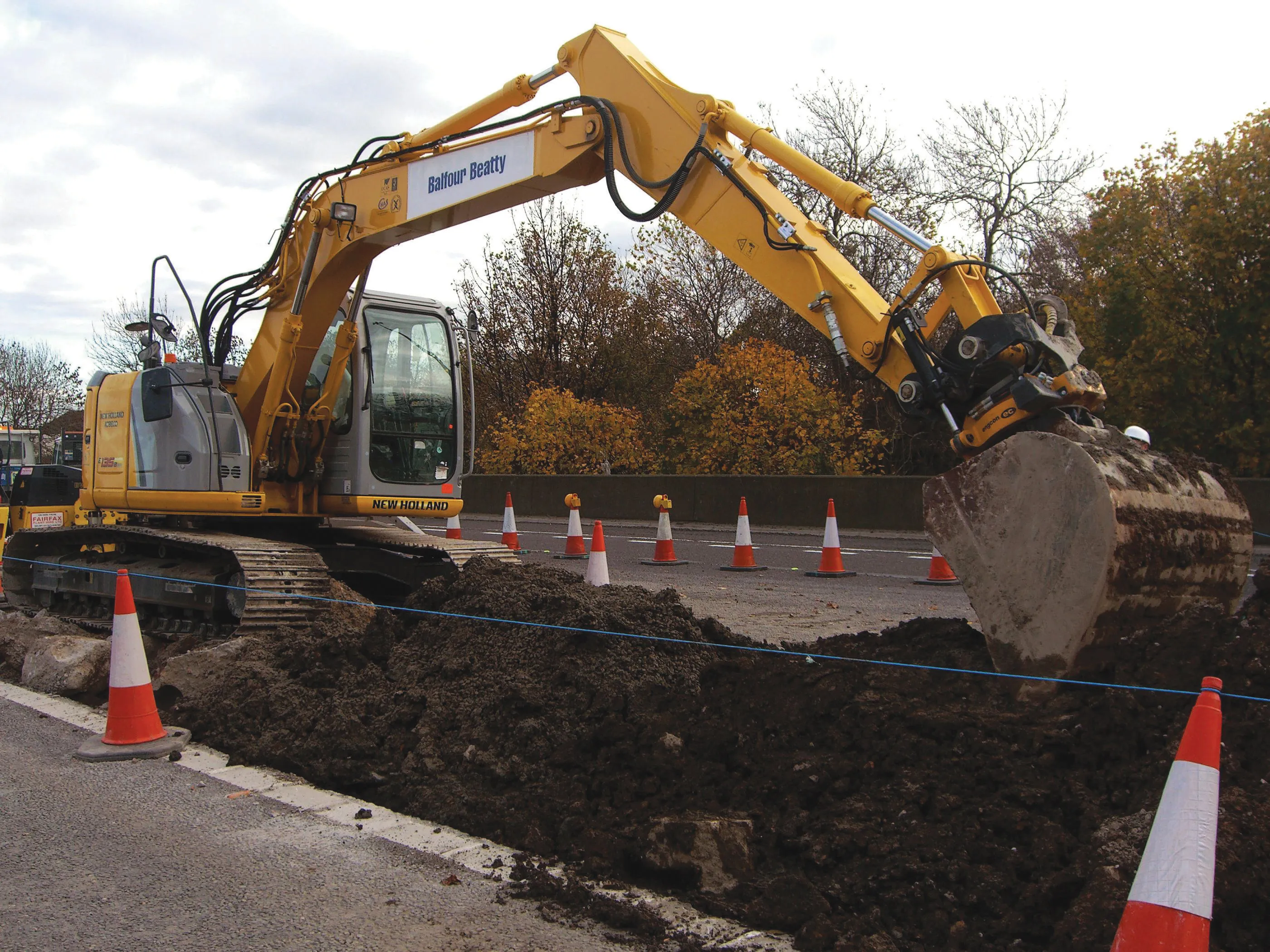
    Zero tailswing excavators from New Holland are part of a plant deal won by civil engineering contractor K Rouse with Balfour Beatty. The machines, 11 E135BSRs and two smaller models, the E80 and E50, are being used on a section of the M621 motorway near the city of Leeds, northern England, to remove existing metal crash barriers and install improved drainage prior to the erection of a new concrete central reservation.
  • The “rollercoaster in the dunes”: Circuit Park Zandvoort
    June 14, 2021
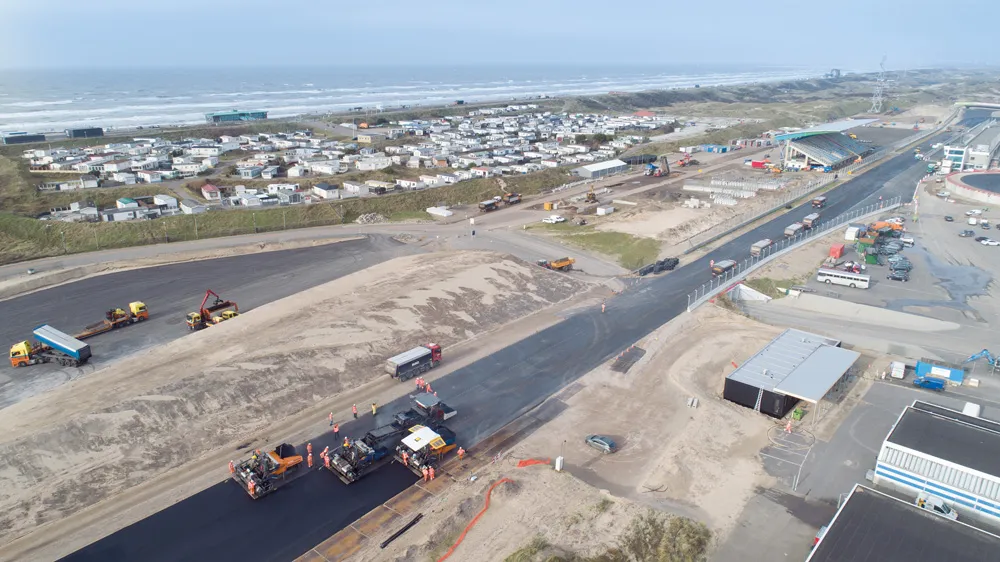
    Some projects are so specialist that there are hardly any construction companies with significant experience to draw on - another reason why it is so valuable to have a partner with the expertise and experience to take things forward. The rehabilitation and modification of the race track in Zandvoort was a project like this.
  • Tunnels - an environmentally attractive option?
    February 21, 2012
    While tunnels are often more expensive than bridges, they can offer environmentally attractive options for transport schemes. Tunnels offer environmentally attractive options for a range of transport infrastructure schemes, but in many cases high construction costs may restrict their use.
  • Implementation of road building projects in Russia’s Moscow may be significantly delayed
    May 15, 2014
    Implementation of some large-scale investment projects for road building in Russia’s capital Moscow may be significantly delayed A series of major documentation issues are the cause of the problem. These have delayed projects for up to nine tenders on the total sum of US$2.6 billion (95 billion rubles), with anomalies having been found by the Russian Federal Anti-Monopoly Service.