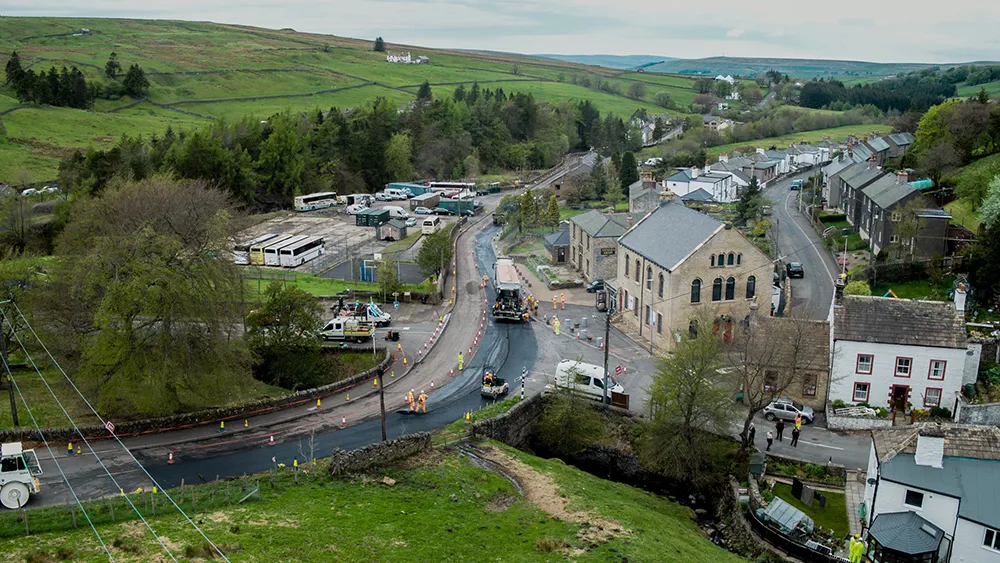
Research reveals that smoother roads can help cut emissions of CO2. This has been announced following the release of the Communication on “A European Strategy for Low-Emission Mobility” (COM (2016) 501) by the European Commission. This covers all transport modes but for road transport, the Communication includes proposals on optimising the transport system, low-emission alternative energy, and low- and zero-emission vehicles.
Three associations active in road construction - EUPAVE (the European Concrete

RSSResearch reveals that smoother roads can help cut emissions of CO2. This has been announced following the release of the Communication on “A European Strategy for Low-Emission Mobility” (COM (2016) 501) by the European Commission. This covers all transport modes but for road transport, the Communication includes proposals on optimising the transport system, low-emission alternative energy, and low- and zero-emission vehicles.
Three associations active in road construction -8501 EUPAVE (the European Concrete Paving Association), EAPA (the 5924 European Asphalt Pavement Association) and FEHRL (the 1364 Forum of European National Highway Research Laboratories) have highlighted the benefits of smoother roads. These bodies have jointly shown the benefit from improving the road pavement to reduce CO2 and other emissions from vehicles. The three associations noted that smooth, well-maintained road surfaces can deliver lower rolling resistance, and lower emissions from vehicles, and so upgrading and maintaining roads should be part of any strategy to reduce road transport emissions. The bodies have jointly called for increased investment in roads and greater alignment of policies on CO2 with policies for upgrading and maintenance of roads.
“Research by FEHRL’s members has shown that smoother roads can reduce CO2 emissions from vehicles to the order of 5% - this adds up to huge savings across the whole network,” said Thierry Goger, secretary general of FEHRL.
“There is a risk that a lack of sufficient investment in our road infrastructure will mean emissions go up instead of down. Authorities should not forget that degraded roads are not only unsafe, but they also work against CO2 reduction targets,” said Carsten Karcher, director of EAPA.
“It would be a shame to miss this opportunity, which requires no new technologies, to reduce emissions while also making gains in terms of safety, efficiency and durability,” said Karl Downey, secretary general of EUPAVE.
Three associations active in road construction -
“Research by FEHRL’s members has shown that smoother roads can reduce CO2 emissions from vehicles to the order of 5% - this adds up to huge savings across the whole network,” said Thierry Goger, secretary general of FEHRL.
“There is a risk that a lack of sufficient investment in our road infrastructure will mean emissions go up instead of down. Authorities should not forget that degraded roads are not only unsafe, but they also work against CO2 reduction targets,” said Carsten Karcher, director of EAPA.
“It would be a shame to miss this opportunity, which requires no new technologies, to reduce emissions while also making gains in terms of safety, efficiency and durability,” said Karl Downey, secretary general of EUPAVE.