Lázár defends Mohács Danube bridge

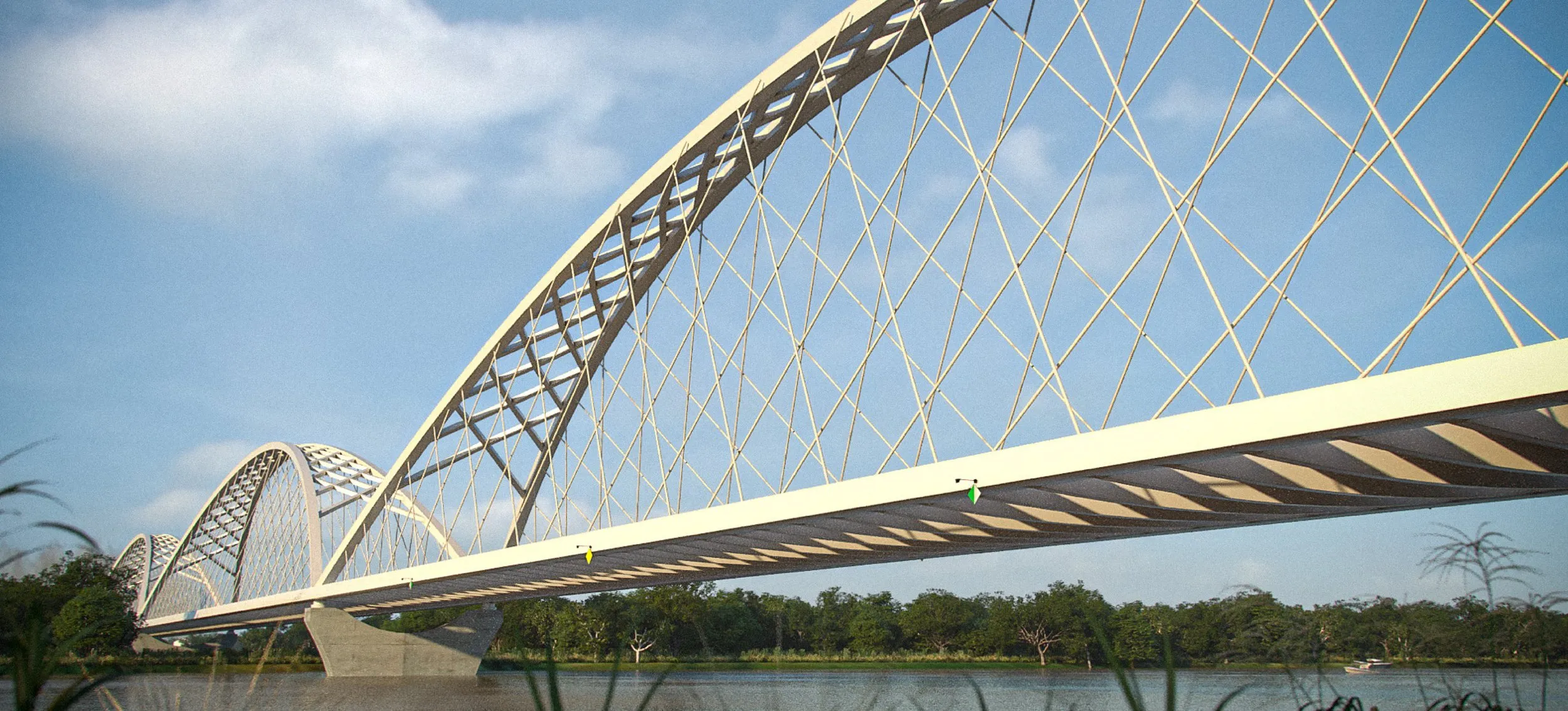
A public tender was won last year by Duna Aszfalt and the design for the controversial 750m-long three-arch structure in Hungary has been done by Hungarian civil engineering firm SpecialTerv.
By David Arminas January 21, 2025 Read time: 2 mins
Hungarian civil engineering firm SpecialTerv has designed the proposed Danube bridge close to the Hungarian town of Mohács (image courtesy SpecialTerv)

Hungary’s transport minister has defended his controversial decision to build a €750 million bridge over the Danube River close to the town of Mohács.

At the end of 2023, János Lázár announced plans for a two-lane bridge close to the border with Serbia. The government hopes that the new crossing will take some of the freight traffic from further east that now crosses Serbia, heading for points in western Europe.

At a recent transport press event, according to the Telex newspaper, Lázár reiterated that it would be good for the local Mohács economy if more freight traffic were to follow Hungary’s M6 motorway and not the M5 motorway and Croatia’s A3 Motorway, both having heavy traffic volumes. Telex noted that the M6 is also a toll road.

A public tender was won last year by Duna Aszfalt. A design for the 750m-long three-arch structure, with a cycle path, has now been completed by Hungarian civil engineering firm SpecialTerv as part of the planned four-lane 19km road connecting motorway M6 and local road 51.

The bridge is in a lightly populated area, noted Telex, with Mohács’ population being only 17,000. But Lázár suggested that the bridge could be the start of making the area more of a transport hub.

The opening of the bridge in 2026 will coincide with the 500th anniversary of the Battle of Mohács. The event marked the end of the medieval Hungarian kingdom and the beginning of Ottoman rule over more than a third of the country and which lasted around 150 years.

Related Content

  • New Zealand lobbyists want tunnel from Panmure to Auckland
    May 13, 2016
    Lobby group New Zealand Council for Infrastructure Development has released a report assessing Auckland's congestion problem which costs the city about US$1.02 billion a year. The city’s increasing car gridlock will grind the economy to a halt, said Stephen Selwood, the group’s chief executive. However, part of the solution, according to the report, could be a major 11km road tunnel from the Panmure district to Auckland’s central business district. Selwood criticised Auckland city’s transport policy p
  • Progress on Serbia’s Zezeljev bridge replacement is slow
    August 30, 2017
    Construction of the Zezeljev rail and road bridge across the Danube River is facing further delays, according to the Serbian government. Work on the 470m-long new bridge was supposed to be finished by this month. But national elections and changes of government have hampered progress, Serbian media have reported. The original bridge was completed in 1961 as a single-track railway line and separate roadway between the cities of Novi Sad and Petrovaradin. NATO attacked the structure five times during its camp
  • A history lesson in private public partnerships
    April 12, 2012
    Michel Démarre gives some historical insights into public-private partnerships conceived to implement urban infrastructure projects, a concept that surprisingly dates back to as early as the 13th century! All over the world today, the role of public authorities in the process of planning and, in most cases, designing, financing and procuring urban roads is paramount. Even for modifications to existing roads, decisions are made by these public authorities (usually after due consultation with the population)
  • Planning for China's future
    July 23, 2012
    The second comprehensive transport study of Jiangsu Province is a good example of road policy in action. Samuel C F Wong, Technical Director, Scott Wilson Ltd explains Jiangsu Province on the eastern coast of China, with a population of 76 million, is one of the fastest growing in the country. Between 1990 and 2007 GDP growth averaged some 16%/year. Economic growth, however, has not occurred evenly. Two-thirds of the province's wealth has accumulated in its southern half. With Jiangsu's rapid economic expan