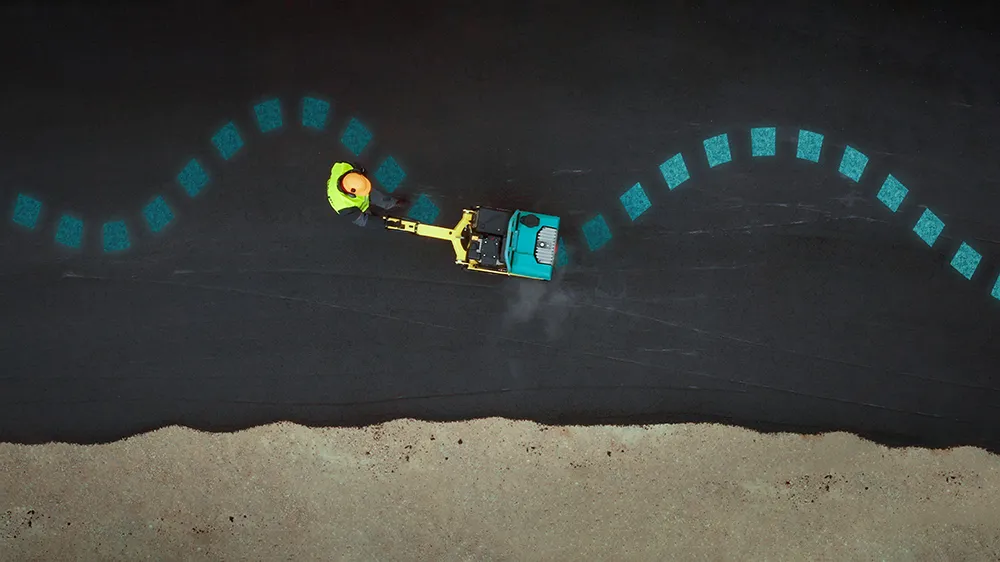
BOMAG’s cleaner milling machine

BOMAG has developed a novel system for reducing dust levels around its milling machines. Called the Ion Dust Shield, this patented system uses ionisation to positively charge dust particles from milled cuttings. The firm says that current dust extraction technology for milling machines focuses on minimising dust levels around the operator. These ensure that the working area is kept free from dust, with this retrieved material then being exhausted to the discharge conveyor, typically at a height of around 5m
November 28, 2018 Read time: 2 mins
BOMAG’s Ion Dust Shield is claimed to reduce dust missions from a milling machine by 80%
172 BOMAG has developed a novel system for reducing dust levels around its milling machines. Called the Ion Dust Shield, this patented system uses ionisation to positively charge dust particles from milled cuttings. The firm says that current dust extraction technology for milling machines focuses on minimising dust levels around the operator. These ensure that the working area is kept free from dust, with this retrieved material then being exhausted to the discharge conveyor, typically at a height of around 5m with a standard machine.
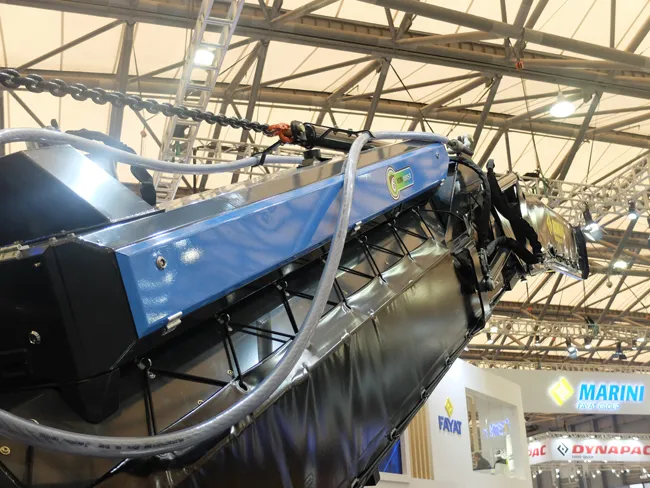
However, the problem with this method according to BOMAG is that micro particles can end up hanging in the air around the machine, taking several hours to fall back to the ground. And it is these micro particles that provide a hazard to human health with a potential for causing lung or heart damage once they enter the body. But by ensuring that the micro particles are positively charged, BOMAG’s Ion Dust Shield ensures that the micro particles stick together so that they are larger and do not hang in the air. Moreover, as the particles are larger they also will not enter the lungs or heart.


According to BOMAG, this patented system reduces dust by 80%. Any dust settling on the machine can be simply washed off at the end of a shift as the particles will remain stuck together. A spokesperson for the firm said, “This is not a filter, so there’s no need to dispose of a contaminated component.” The spokesperson continued, “We have a system that converts dangerous micro particles into non dangerous large particles.”

The system is being introduced first on the firm’s smaller milling machines as these are typically used for operations in urban locations, where there may be concerns about dust.
For more information on companies in this article

Related Content

  • Wirtgen machines help with road recycling in Italy
    March 18, 2016
    One of the first Wirtgen W 200 Hi cold milling machines off the assembly line is now being used for road recyling work in southern Europe. The versatility of the machine due to its novel 400mm offset drum capability has proven extremely useful for the contractor in Italy. Tuscany–based Endi Asfalti is now using the large and highly productive W 200 Hi for a wide range of milling jobs that would previously have been carried out using a combination of large and small milling machines. The proven W 200 milling
  • Runway refurbishment at Leipzig/Halle airport
    May 4, 2022
    Leipzig/Halle airport in Germany is now benefiting from a newly rehabilitated runway as well as a number of taxiways
  • Power Curbers sees strong machine sales
    May 15, 2019
    Power Curbers has seen strong sales of its machines during 2018, with demand expected to continue through 2019 – Mike Woof writes Power Curbers has seen strong sales for its slipformers during 2018, with customers keen to replace ageing equip-ment. Sales of the 5700-C have been very healthy. One of the key changes in the market that Power Curbers has observed is with the growing interest in machine control solutions amongst its customers. Power Curbers said that there has been a massive change in custom
  • Airport runway rebuild at Bologna
    May 15, 2019
    Rebuilding a runway requires special attention to detail to maximise efficiency and safety Airport runways face special challenges with regard to the loads they carry on a daily basis, particularly when aircraft are landing. A modern jet aircraft will typically land at speeds of around 240-260km/h, with a laden 747 weighing as much as 265tonnes at the end of a long flight. The stresses these large aircraft place on runway surfaces are enormous and not just with the massive impact forces exerted during