IRF's 2nd International Conference on Roads and Environment reveals how to make roads greener, cleaner and healthier, and follows through with action recommendations IRF's Conference in Geneva on 10-11 November, 2008 put three issues in sharp focus: innovative materials to save energy and other resources, inspiring solutions for water management; an integrated approach to noise and air pollution; and greenhouse gas (GHG) emissions monitoring, accounting and offsetting. Some 140 delegates from 36 countries l

IRF's 2nd International Conference on Roads and Environment reveals how to make roads greener, cleaner and healthier, and follows through with action recommendations
IRF's Conference in Geneva on 10-11 November, 2008 put three issues in sharp focus: innovative materials to save energy and other resources, inspiring solutions for water management; an integrated approach to noise and air pollution; and greenhouse gas (GHG) emissions monitoring, accounting and offsetting.Some 140 delegates from 36 countries listened to presentations from 25 acknowledged international experts in their various fields, and discussed the latest insights and innovations in technology, equipment and materials aimed at reducing the impact of road infrastructure on the environment.
Materials
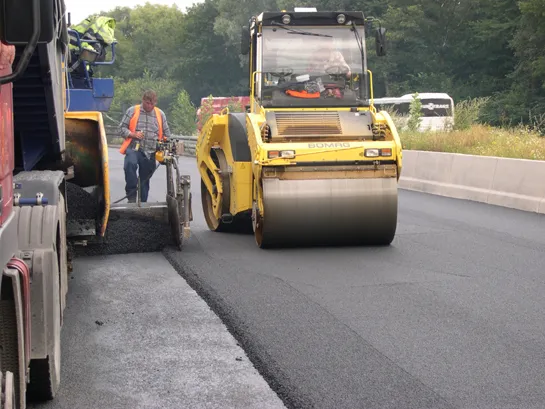
Under the chairmanship of Carl Reller of the New Zealand Transport Authority, delegates heard how life-cycle analysis can lead to sometimes unexpected, but sound, conclusions for the development of one product, or method, over another; how road pavements can become part of a vast heat-exchange system; how the production and application of some asphalt mixes can save precious energy; how pavement binders can be made from sustainable agricultural sources; of the manifold potential of reflective sheeting replacing electric powered road signs and signals; how anti -smog technology can transform roads into air purifiers rather than pollution sources; and, of the requirements of the international standard ISO 14001 on Environmental Management, in developing benchmarks.
Water management
Jean Beauverd of
Noise and air pollution
Under the chairmanship of Dr Carl Thodesen of
Emissions
For any activity, today, the world's environmental focus tends to be concentrated on emissions.
Road building and maintenance is not among the largest direct sources of emissions - unlike the immediate users of its services. Nevertheless, the road industry takes emissions very seriously. Under the chairmanship of Dimitris Mandalozis of the Attica Tollway Operations Authority, Greece, presentations covered the CO2 modelling of transport, the link between road design and emissions, using the environmental footprint of vehicles for road pricing, and monitoring and accounting of GHG emissions from road infrastructure - the IRF GHG Calculator.
Action recommendations
The Conference stressed the need for sound and realistic policies and measures to address the environmental challenge. In solving the dilemma between economic development and environmental protection price mechanisms alone are unlikely to be politically and socially acceptable, nor sufficient to address the challenge in full. Therefore, cost/benefit analysis should be the basis of any political, regulatory or fiscal measure aimed at protecting the environment. A solid traffic policy is a key starting point; "stop-and-go" traffic conditions produce very high emission levels and "keep the traffic moving" is a key objective of any traffic management system. Limiting road capacity does not improve environmental conditions. Setting guidelines and green rating systems for road infrastructure planning, construction and management does improve the environment.
The many cases presented showed that business is part of the solution. The private sector should be strongly encouraged and recognised for its commitment to the environment. The sector's ecological products and processes should be given due attention and priority when planning construction and its research supported by adequate funds. Support for the adoption of carbon and energy saving technologies is a priority. And so, life-cycle-analysis methodology should be adopted in all material/technology assessments. The IRF's Greenhouse Gas Calculator should be widely used to measure, monitor and thus help control, emissions. Accounting for emissions performance must become part of the bidding process for all projects.
For emissions control, the use of tools to determine the carbon footprint of road infrastructure and traffic must be encouraged. They are vital to reduce those footprints through good design and optimised logistic chains in the transport industry. Emissions saving processes such as warm and cold asphalt must be encouraged. In urban areas, road plans are needed that give special consideration to pedestrians, cyclists and public transport. Such planning will improve air quality and reduce CO2 emissions.
Water pollution from roads and traffic must always be assessed to enable prevention and mitigation of - and compensation for - harmful effects. Roads themselves need to be made climate-proof and flood risks carefully assessed and addressed when planning new roads or upgrading existing ones.
Asphalt recycling technologies and applications need to be further developed and applied: they have proved to be effective in addressing environmental concerns. Exchange of best practices on application and maintenance of ecologically friendly road signs and markings should be favoured. They reduce energy consumption, water pollution and GHG emissions. Paved surfaces as sources of energy should be further investigated. Tested technology such as asphalt solar collectors should be promoted.
Keep traffic flowing is the mantra for local transport policy in urban areas. Limiting road capacity does not keep it flowing. Intelligent Transport Systems help reduce emissions and are essential for a sound traffic management. They should be installed systematically. Noise pollution needs an integrated approach, taking account of the interaction of pavement, tyre and vehicle. Silent pavements can contribute as much to noise reduction as tyres or vehicle engines.
These conference recommendations are the essential guidelines for the road industry and our future actions at the IRF. We and our members are determined to take them forward and to collaborate in sharing ideas, research, technologies and best practices.