Soaring over 271m above the Colorado River, the Hoover Dam Bypass overlooks one of America’s greatest icons and assets. The October 2010 opening of the bypass improves the security of the historic Hoover Dam by removing through traffic from US Route 93. This has reduced its vulnerability to a terrorist attack against an international landmark and guarded the most sustainable source of electricity and the scarce water supply for the entire southwestern United States. By diverting traffic from the hairpin tur

Soaring over 271m above the Colorado River, the Hoover Dam Bypass overlooks one of America’s greatest icons and assets. The October 2010 opening of the bypass improves the security of the historic Hoover Dam by removing through traffic from US Route 93. This has reduced its vulnerability to a terrorist attack against an international landmark and guarded the most sustainable source of electricity and the scarce water supply for the entire southwestern United States.
By diverting traffic from the hairpin turns and two-lane bottleneck approaching and crossing the dam, the bypass improves driver and pedestrian safety. Bypassing the dam also reduces travel time and fuel consumption for motorists traveling between Las Vegas and Phoenix while strengthening the international economy by restoring a critical freight trucking route between the United States and Mexico, which was disrupted when trucks were detoured from the dam following the 9/11 attacks.
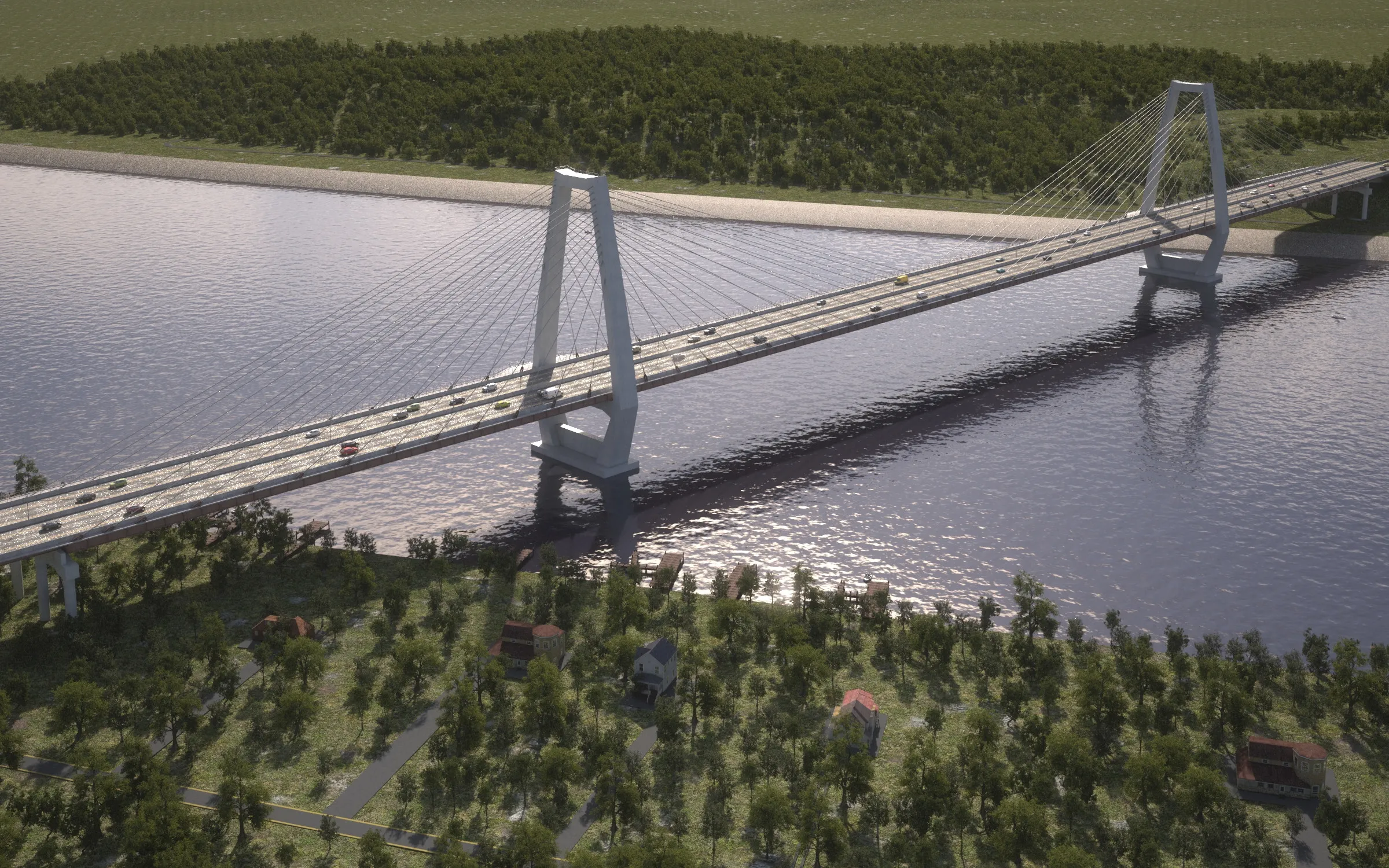
In addition to the bridge’s safety, security, mobility and economic impacts, the structure itself demonstrates design excellence. The 579m long Colorado River crossing is the centerpiece of the project, connecting new approaches on both sides of the river and eight other bridges. It sets the record as the highest and longest concrete arch bridge in the Western Hemisphere and features the world’s tallest precast concrete columns. The innovative hybrid structure is designed to complement the dam with the high-performance concrete arch while limiting the load demands with a modern steel superstructure. It is the first steel-concrete hybrid arch bridge in the United States.
The spectacular setting provides a backdrop for engineering innovation but also proved to be the greatest challenge. The complex topography was rugged, steep and uneven. Just getting to the project site proved a challenge. Construction crews spent two years blasting their way through mountainous rock to carve the path for 6.9km of new approach roadway on each side of the Black Canyon, where Arizona and Nevada would be connected by the river bridge.
The canyon below the dam is a 244m gorge with dramatic rock cliffs, steep canyon walls and a vast geological palette. Working in such a setting required rock cuts and fills exceeding 30.5m in height. Workers and equipment were lowered into the canyon by cranes, using a combination of machinery and explosives to carve out platforms to anchor the bridge foundations. Rock debris slowly ascended out of the canyon via the same cranes to avoid dropping rock on the buildings housing the dam’s outfall structures below. The 49°C desert days required workers to pour concrete at night; even then, construction crews required cooling tubes filled with liquid nitrogen to prevent the concrete from setting too quickly. Extreme wind patterns presented an even greater hazard during construction, with a mean wind speed of 112km/h. Everything about the construction was extreme.
The project’s legacy includes environmental and cultural stewardship. Because construction of the approach bridges encroached on migration routes, designers incorporated underpasses for bighorn sheep to safely avoid the highway. Many native plants that were displaced by construction were collected and stored in a National Park Service nursery, then replanted. Additionally, changes to the approach alignment helped save 157m3 of rock excavation and reduce the project footprint by 6ha. Water sources temporarily disrupted by construction were also relocated.
The Hoover Dam Bypass set new standards for successful project management. The project was managed by a six-agency project management team, led by the2408 Central Federal Lands Highway Division of the US 2410 Federal Highway Administration. The other major project stakeholders included the states of Arizona and Nevada, the 2413 Bureau of Reclamation, the 2407 Western Area Power Administration and the 2412 National Park Service. The project design team consisted of 2418 HDR, 6726 Jacobs Engineering, and 3355 TY Lin International. The large, complex team delivered the project on budget without any disputes or claims.
At the bridge dedication, US Transportation Secretary Ray LaHood set this grand project in a historical context.
“The workers who built the bridge have left a legacy worthy of the people who built the dam 75 years ago,” LaHood said. “This breathtaking dam and beautiful new bridge also demonstrate a larger point: daring projects do not solve today’s problems, they support tomorrow’s possibilities.”
The Hoover Dam Bypass project, completed by HDR, TY Lin International, and Jacobs Engineering, received the 20122462 IRF GRAA for excellence in design.
By diverting traffic from the hairpin turns and two-lane bottleneck approaching and crossing the dam, the bypass improves driver and pedestrian safety. Bypassing the dam also reduces travel time and fuel consumption for motorists traveling between Las Vegas and Phoenix while strengthening the international economy by restoring a critical freight trucking route between the United States and Mexico, which was disrupted when trucks were detoured from the dam following the 9/11 attacks.
In addition to the bridge’s safety, security, mobility and economic impacts, the structure itself demonstrates design excellence. The 579m long Colorado River crossing is the centerpiece of the project, connecting new approaches on both sides of the river and eight other bridges. It sets the record as the highest and longest concrete arch bridge in the Western Hemisphere and features the world’s tallest precast concrete columns. The innovative hybrid structure is designed to complement the dam with the high-performance concrete arch while limiting the load demands with a modern steel superstructure. It is the first steel-concrete hybrid arch bridge in the United States.
The spectacular setting provides a backdrop for engineering innovation but also proved to be the greatest challenge. The complex topography was rugged, steep and uneven. Just getting to the project site proved a challenge. Construction crews spent two years blasting their way through mountainous rock to carve the path for 6.9km of new approach roadway on each side of the Black Canyon, where Arizona and Nevada would be connected by the river bridge.
The canyon below the dam is a 244m gorge with dramatic rock cliffs, steep canyon walls and a vast geological palette. Working in such a setting required rock cuts and fills exceeding 30.5m in height. Workers and equipment were lowered into the canyon by cranes, using a combination of machinery and explosives to carve out platforms to anchor the bridge foundations. Rock debris slowly ascended out of the canyon via the same cranes to avoid dropping rock on the buildings housing the dam’s outfall structures below. The 49°C desert days required workers to pour concrete at night; even then, construction crews required cooling tubes filled with liquid nitrogen to prevent the concrete from setting too quickly. Extreme wind patterns presented an even greater hazard during construction, with a mean wind speed of 112km/h. Everything about the construction was extreme.
The project’s legacy includes environmental and cultural stewardship. Because construction of the approach bridges encroached on migration routes, designers incorporated underpasses for bighorn sheep to safely avoid the highway. Many native plants that were displaced by construction were collected and stored in a National Park Service nursery, then replanted. Additionally, changes to the approach alignment helped save 157m3 of rock excavation and reduce the project footprint by 6ha. Water sources temporarily disrupted by construction were also relocated.
The Hoover Dam Bypass set new standards for successful project management. The project was managed by a six-agency project management team, led by the
At the bridge dedication, US Transportation Secretary Ray LaHood set this grand project in a historical context.
“The workers who built the bridge have left a legacy worthy of the people who built the dam 75 years ago,” LaHood said. “This breathtaking dam and beautiful new bridge also demonstrate a larger point: daring projects do not solve today’s problems, they support tomorrow’s possibilities.”
The Hoover Dam Bypass project, completed by HDR, TY Lin International, and Jacobs Engineering, received the 2012
Are you up for the challenge?
Since their launch, the IRF GRAAs have provided global awareness for over 100 projects in 30 countries and highlighted how road programmes help achieve broader development goals. The IRF is now taking applications across 11 categories. The deadline for submitting an entry in the 2013 GRAA competition is May 31, 2013.
Find out more online at %$Linker: