
Congested cities, inadequate public transport, unsafe roads, pollution, and high vehicle acquisition costs all point to the urgent need to rethink mobility. The introduction of technologies related to connectivity, automation, electrification, and digital innovation is challenging and transforming a dynamic and ever-changing transportation sector. While digital technologies can provide the transport sector with unprecedented instruments towards a sustainable future, they also present a host of new challenges as we shift towards new mobility models. The car industry is currently under pressure: new forms of ownership (shared mobility), and e-vehicles (decarbonisation), are forcing a modal shift to rail and waterways, user-pays and polluter-pays cost allocation schemes, and changes in urban mobility.
The International Road Federation (IRF), based in Geneva, Switzerland has a history of more than 70 years of being at the forefront of innovation in the road transport sector. It has now launched the Connected and Autonomous Mobility Committee (CAMC) to respond to society's extensive challenges. The committee is led by the International Road Federation (IRF), in collaboration with the European Union Road Federation (ERF) and the European Association of Operators of Toll Road Infrastructures (ASECAP). The group aims to build a shared vision that will guide the upcoming transition period towards a mixed-traffic scenario, such as conventional and autonomous vehicles.
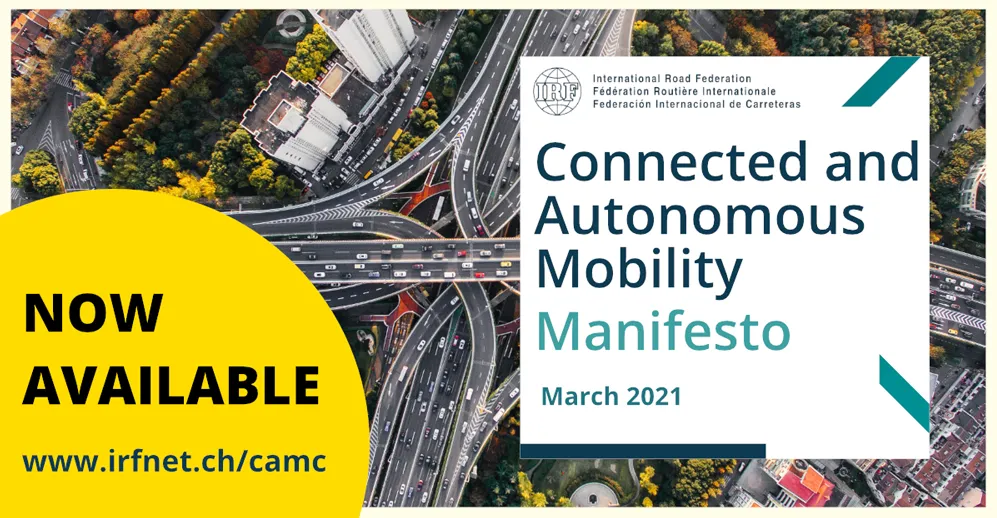
The manifesto summarises the initial conversation around the main challenges identified by the three workstreams guiding the IRF Connected and Autonomous Mobility Committee (CAMC) work: Regulatory framework, Future work and social needs, and Technological innovations.
Regulatory framework
The lack of adequate physical road infrastructure hinders our sector's ability to achieve higher autonomous driving levels. Over time, digital infrastructure will enhance physical infrastructure and create a safe and robust operational design domain (ODD) in cooperation with the intelligent vehicle. It is crucial to develop meaningful performance-based norms, standards, and specifications in a public procurement world.
Future workforce and social needs
The challenges of automation, new technology and the future of work are some of the most critical issues that workers are facing today. Automation and technological advances undoubtedly present challenges, but also opportunities. To this extent, the public and private sectors require guidance and support about future staff needs and roles in how both sectors should work together to maximise connectivity and automation benefits.
Technological innovations
The implementation of evolving technological trends has started in many segments of the transport chain. Despite significant advancements, the deployment of autonomous vehicles remains a challenge. Additionally, there is limited research regarding the improvement of road infrastructure to serve smart vehicles. Hence, developing an autonomous driving system that includes an engineering approach should cover all essential entities, vehicles, infrastructure, and the management system. This workstream addresses the concept of connected infrastructure, built on digitalisation elements, and the availability of relevant static and dynamic information.
The IRF CAM Committee is open to IRF members, road operators, technology providers, research institutions, national and regional authorities, associations, and other organisations upon invitation. ■
• More information is available on : www.irfnet.ch