Brazil's improved Mercosur route will boost capacity and cut travel time - Mauro Nogarin writes. The Régis Bittencourt Highway is one of the main access routes of the Mercosur traffic. It has a length of 400km and connects the main cities of São Paulo and Curitiba, which allows for products to enter from the southeast toward the rest of the southern part of Brazil and later transit to Argentina, Paraguay and Uruguay. Products also flow into Brazil from Mercosur through this major highway. The cost of the hi

Brazil's improved Mercosur route will boost capacity and cut travel time - Mauro Nogarin writes
The Régis Bittencourt Highway is one of the main access routes of the Mercosur traffic. It has a length of 400km and connects the main cities of São Paulo and Curitiba, which allows for products to enter from the southeast toward the rest of the southern part of Brazil and later transit to Argentina, Paraguay and Uruguay. Products also flow into Brazil from Mercosur through this major highway. The cost of the highway is US$350 million.
There have been plans since the early 1960s to widen this road to four lanes, especially in the Serra do Cafezal, a 30.5km stretch of road through the mountains. As of November 2014, 17.5km were completed.
But there is a very good technical explanation for the slow rate of progress. There are various geological obstacles that complicate construction, as well as topographical problems. There is also a very vulnerable ecosystem that borders on the State Park Serra do Mar close to the Atlantic Ocean. The environmental permit granted by the Brazilian Institute of Environment and Renewable Natural Resources (IBAMA) requires engineering to seek to minimise the environmental impact in order not to upset the delicate balance of the ecosystem of the Serra do Cafezal.
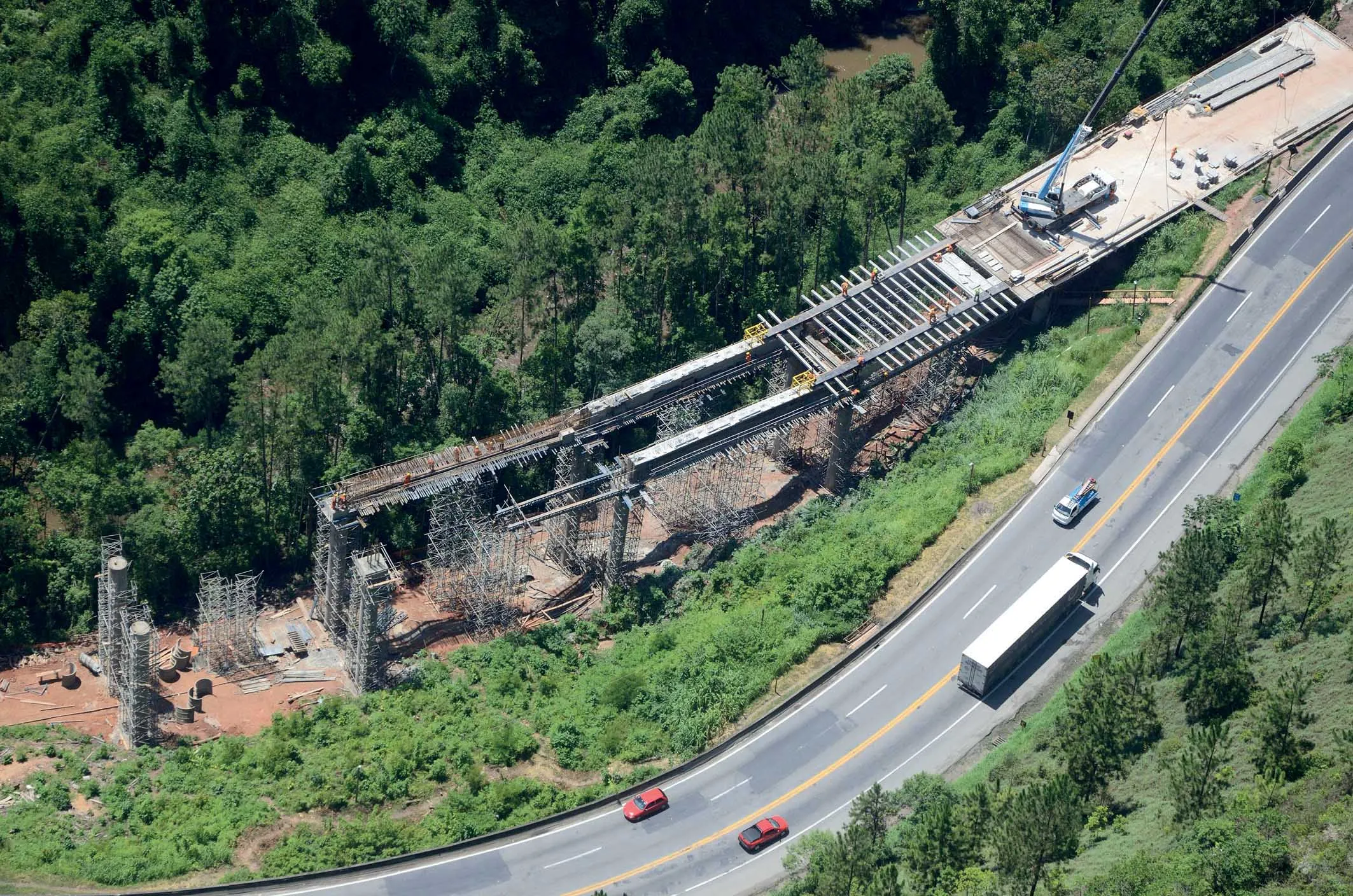
When, in 2008, the Arterias Group assumed the concession to build the Régis Bittencourt Highway, construction of the second lane of this section was a high priority. For this reason a different project was developed from what was conceived in previous years. Their project was easier to execute as there were no environmental restrictions at the time, which were added in subsequent years. The new design implements a series of containment works to protect the fragility of the geological structure of the area, with the construction of four tunnels and 34 overpasses and bridges, which include a high degree of technical complexity, but that respect the environmental regulations. Only two million m3 of earth will be moved during the entire project.
The area is located between the towns of Juquitiba and Miracatu near the city of São Paulo and the goal is to maintain traffic flow on the freeway and avoid traffic congestion during peak hours, both daily and seasonal.
According to the new project schedule of the construction, work began in 2011 and will be completed in February 2017. Even with little more than half of the work already completed, there are visible benefits. It has reduced the number of crashes and reduced bottlenecks in the flow of vehicles that previously were caused by the low speed of heavy trucks.
The construction delays have caused problems, in particular by increasing the construction time and delivery of the finished product. The delays have also increased construction costs, which is being reflected in the price of the final work. Of the nine sections of which the project consists, four were already executed, four are under construction and one starts in the course of this year. Since 2013 nearly 1,500 people have worked on this project, and according to the current work schedule work will be completed at the end of 2016.
The project team is using the well-proven New Austrian Tunnelling Method (NATM) method for tunnel excavation. So far, 500m of the estimated 1,800m of tunnel have been driven. In the stretches where hard rock was detected, explosives were used prior to bringing in the excavation equipment. To build Tunnels 1 and 2, which are located at the northern end of the highway, it was necessary to carry out some supplementary work so as to contain the hillsides. Feldspar was encountered during the construction of Tunnel 1 South, which has currently been driven by some 90m.
During the construction of one of the most difficult overpasses due to the steep slopes and difficult access to the site, it was necessary to implement the method of incremental launch, for a stretch of 800m. This method allowed implementation without requiring the width of the highway to be taken up with heavy equipment supplying construction materials. This would have also caused traffic congestion throughout the construction phase.
The incline of the road is 6% and the design speed along the entire stretch is 60km/h. Both the construction of beams and pre-stressed slabs of the other bridges were made in a concrete factory, to reduce costs and the travel time of the pieces to work site. The volume of concrete required for the realisation of all bridges and overpasses was calculated by engineers to be 150,000m³.
The Régis Bittencourt Highway is one of the main access routes of the Mercosur traffic. It has a length of 400km and connects the main cities of São Paulo and Curitiba, which allows for products to enter from the southeast toward the rest of the southern part of Brazil and later transit to Argentina, Paraguay and Uruguay. Products also flow into Brazil from Mercosur through this major highway. The cost of the highway is US$350 million.
There have been plans since the early 1960s to widen this road to four lanes, especially in the Serra do Cafezal, a 30.5km stretch of road through the mountains. As of November 2014, 17.5km were completed.
But there is a very good technical explanation for the slow rate of progress. There are various geological obstacles that complicate construction, as well as topographical problems. There is also a very vulnerable ecosystem that borders on the State Park Serra do Mar close to the Atlantic Ocean. The environmental permit granted by the Brazilian Institute of Environment and Renewable Natural Resources (IBAMA) requires engineering to seek to minimise the environmental impact in order not to upset the delicate balance of the ecosystem of the Serra do Cafezal.
When, in 2008, the Arterias Group assumed the concession to build the Régis Bittencourt Highway, construction of the second lane of this section was a high priority. For this reason a different project was developed from what was conceived in previous years. Their project was easier to execute as there were no environmental restrictions at the time, which were added in subsequent years. The new design implements a series of containment works to protect the fragility of the geological structure of the area, with the construction of four tunnels and 34 overpasses and bridges, which include a high degree of technical complexity, but that respect the environmental regulations. Only two million m3 of earth will be moved during the entire project.
The area is located between the towns of Juquitiba and Miracatu near the city of São Paulo and the goal is to maintain traffic flow on the freeway and avoid traffic congestion during peak hours, both daily and seasonal.
According to the new project schedule of the construction, work began in 2011 and will be completed in February 2017. Even with little more than half of the work already completed, there are visible benefits. It has reduced the number of crashes and reduced bottlenecks in the flow of vehicles that previously were caused by the low speed of heavy trucks.
The construction delays have caused problems, in particular by increasing the construction time and delivery of the finished product. The delays have also increased construction costs, which is being reflected in the price of the final work. Of the nine sections of which the project consists, four were already executed, four are under construction and one starts in the course of this year. Since 2013 nearly 1,500 people have worked on this project, and according to the current work schedule work will be completed at the end of 2016.
The project team is using the well-proven New Austrian Tunnelling Method (NATM) method for tunnel excavation. So far, 500m of the estimated 1,800m of tunnel have been driven. In the stretches where hard rock was detected, explosives were used prior to bringing in the excavation equipment. To build Tunnels 1 and 2, which are located at the northern end of the highway, it was necessary to carry out some supplementary work so as to contain the hillsides. Feldspar was encountered during the construction of Tunnel 1 South, which has currently been driven by some 90m.
During the construction of one of the most difficult overpasses due to the steep slopes and difficult access to the site, it was necessary to implement the method of incremental launch, for a stretch of 800m. This method allowed implementation without requiring the width of the highway to be taken up with heavy equipment supplying construction materials. This would have also caused traffic congestion throughout the construction phase.
The incline of the road is 6% and the design speed along the entire stretch is 60km/h. Both the construction of beams and pre-stressed slabs of the other bridges were made in a concrete factory, to reduce costs and the travel time of the pieces to work site. The volume of concrete required for the realisation of all bridges and overpasses was calculated by engineers to be 150,000m³.